Sadlers Wells East
April 23 2026
By Stacey Prickett
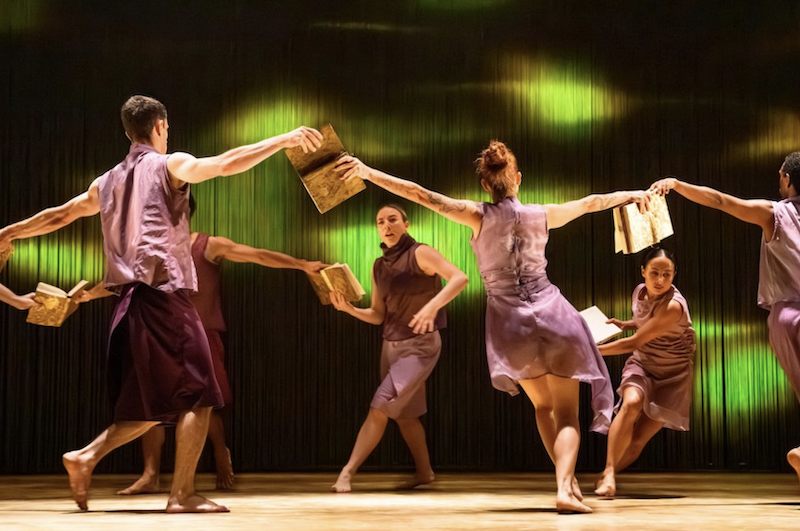
Projections of dappled light, sounds of insects and birds create an idyllic landscape, when, holding a book, Tanisha Addicott is raised up above a ring of dancers. The circle gradually dissipates as each one is drawn into another world created by the books they hold. Extended passages of flowing solo and partnering work occur almost unconsciously, as the dancers remain enthralled by the words on the pages. Their circular arcing arms, deep pliés and lunges contrast with tilted extensions and shoulder rolls, while partnering phrases cantilever off centre. Tightly linked despite the absence of a rhythmic pulse in Theirry Pécou’s score, a strong sense of community emerges, reinforcing the ‘we’ in Shobana Jeyasingh’s We Caliban. Here, Caliban is not a solo ‘savage’ but representative of a people, backed by chorus of dancers moving as one at times, intertwining then breaking apart to come back together. Solo Caliban is not on his own. Rather than illiterate, heathen, barbarous people, as labelled by New World colonisers, the group conveys a serene, contented aura. Traces of bharatanatyam technique emerge at moments, legs in aramandi and a strong clarity of line with mudras accenting sharp arm gestures, familiar phrases in Jeyasingh’s repertory. The sounds of nature remain, played against an increasingly atmospheric electronic score. Associations shift as the partnering becomes more dynamic, responding to an undercurrent of tension rising in the score.
Jeyasingh’s take on Shakespeare’s The Tempest (dramaturg Uzma Hameed) illuminates tensions and connections between the well-known narrative and contemporary events. Artistic collaborations create a multi-media, hour-long piece of exceptional dancing. Mayou Trikerioti’s costumes in purple hues and sparse props reinforce locations, roles and power relationships across seven scenes. Bookended by opening and closing sections, the play’s action is conveyed in part through words and projections, relieving the dancers from strict narrative labour. Lighting by Floriaan Ganzevoort, with video and projection designed by William Duke transfer us to different places and dramatic events introducing glimpses of historical reality. Projected images of Queen Elizabeth I and Sir Walter Raleigh accompanied by a reading of the 1584 royal charter remind us of how the world changed when the Queen granted Raleigh license to explore and take possession of lands not inhabited by Christian people. Underpinning the narrative threads are words, on the screen, in books and spoken aloud. The act of colonisation unfolds onstage in abstract ways, focusing at first on Prospero’s (Harry Ondrak-Wright) loss of power to his brother Antonio (Oliver Mahar) in the court of Milan. His courtiers rebel against the usurped Duke, their physical altercations extended through staffs that block his passage. Different roles are signalled through movement as the courtiers respond in unison to their ruler’s controlling gestures. The addition of costume components, such as a cape for Prospero, voluminous arm sleeves for his daughter Miranda (Holly Vallis) and a sash for his scheming brother further differentiate the characterisation. The remaining chorus of dancers shift seamlessly between allegiances, with Gabriel Ciulli, George Gregory, Tabitha O’Sullivan, Raul Reinoso Acanda rounding out Group Caliban and courtiers.
Surviving the storm, native inhabitants become objects of curiosity to the expelled Duke and his daughter. Miranda and Caliban explore each other’s differences, in language, customs and skin colour. An aristocratic dominance emerges through expectations of subservience in bows, a hand proffered for kiss, a chair providing comfort and height, yet Prospero’s challenges to the solo Caliban (Reinoso Acanda) reinforce derogatory attitudes to colonised others. Relationships are played out in dynamic shifts that are embodied, as seen in Ferdinand’s (Gregory) aristocratic stance and the formality of an arranged marriage to Miranda with lifts balletic in style. The collective of artistry moves us through the scenes, the musical instrumentation adding layers of complexity and drama. Although the solo Caliban enacts subservient gestures, they feel performative as an underlying resistance emerges with the collective Group Caliban and a return to nature. Prospero’s book lies in sheets on the stage, the shipwrecked intruders disappear. A duet between Reinoso Acanda and Addicott echoes some of the partnering of the opening but intensifies in risk and speed. The reappearance of Group Caliban with their books reasserts the collective ‘we’ that survives the onslaught of colonialism.