Jiva Studio
May 9 2026
Reviewed by Jeevika Bhat for Line & Verse
Image credit: Bhavani Nataraj
Jiva Performing Arts’s May 2026 Solo Studio Showcase featured a range of budding to seasoned artists in an intimate celebration of traditional, classical, and contemporary South Asian dance.
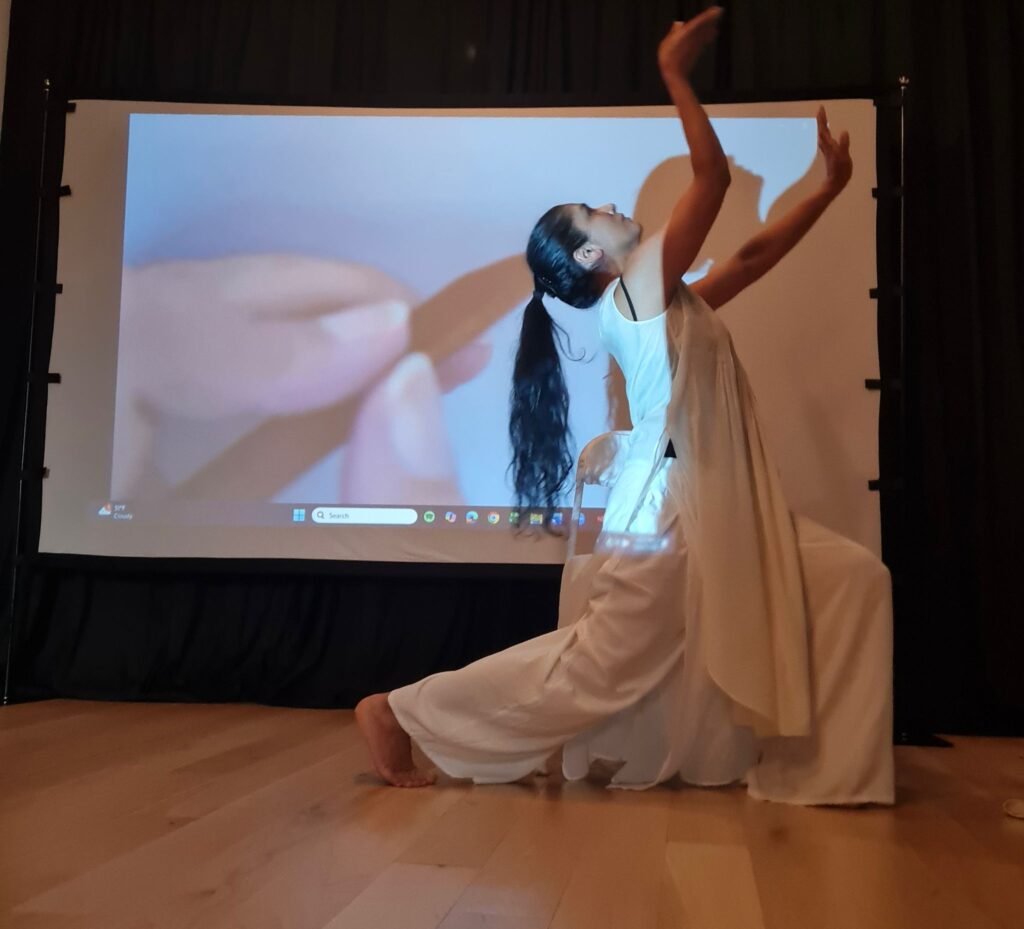
The afternoon opened with Ammr Vandal, who presented a contemporary kathak soul search inspired by Nastaliq calligraphy, asking, “what’s in a name?” In the projection, the artist’s hand was so glacial in writing that the strokes appeared like sedimentary rock, vertical lines marking the ink flow in segments. Yet, when the artist moved their hand away, they were so sharp, calculated, and quick to leave. In the choreography, Vandal reflected this quality in the calm ferocity of her gaze, the way she moved primarily in the negative space between beats of the taal, and how her wrists punctuated and plucked the strings of the music. I was particularly drawn to the moment she flicked her ponytail, and generally, the dhrut of her choreography juxtaposed with the vilambit projections of calligraphy. As Vandal danced in front of the projection, which fluidly lit her form, I felt myself craving that she wore a more sheer skirt, such that the light would dance and move through her costume and still display text through the shadows on screen. I also craved a subtitle on the projection so we could know what was being written, but I questioned if not knowing was the point – I was reminded of Shayok Misha Chowdhury’s Public Obscenities, a Bengali/English play, which at times did not give the audience subtitles simply because we were not meant to understand. Overall, Vandal’s piece was emotional, personal, and poignant. It was story heavy: the theme of identity became so important that the actual movements ceased to matter.
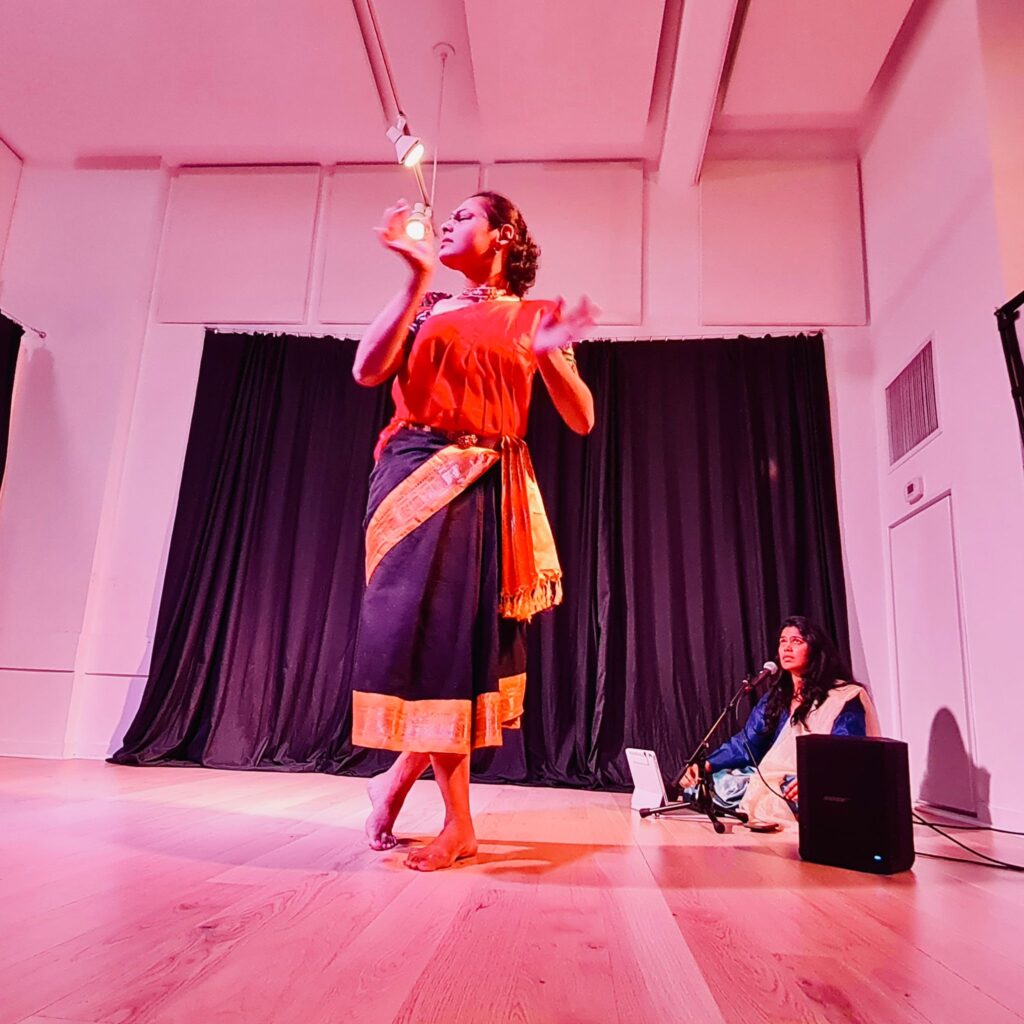
Swati Seshadri, with Samyukta Ranganathan on vocals, presented two pieces, an Urdu ghazal which explored romance and remembrance in modern love, and a three part jugalbandhi which involved the audience as the percussion element, along with Ranganathan responding on vocals and Seshadri on dance.
Their first piece was a lovely slice of life, a study of the art of noticing and remembering in real time. I noted Seshadri’s skill in endowment (by Uta Hagen’s theatrical definition) – the way she assigned spatial consistency to the room, the weight of the ring on her finger, the viscosity of the soup (sambar?) she was stirring, all depicted with precise clarity. I also enjoyed watching Ranganathan watch Seshadri as she sang, and noting the real time emotional exchange between the artists. In terms of the narrative, I appreciated how we weren’t given a conclusive answer to what actually had happened, or where the lover had gone. We were seeing the story unfold purely from the perspective of the dancer’s memory, leading us to the same wistful nostalgia that her character was experiencing.
Their second piece was playful and experimental. Even the choreography felt fresh, utilizing hastas which are typically underused in nritta contexts. The audience came together to clap in adi talam, with Seshadri playing the role of both conductor and dancer. I found it amusing that we weren’t able to applaud after her detailed and fast paced jathis, since our hands were too occupied with our homework of keeping the rhythm. I’ve recently been thinking about attendees of Carnatic music concerts who loudly and visibly put talam in sync with the mridangam, and I wonder if there is an element of self justification in the action. To be in public is by nature a performance. Even as audience members, we are seen, perhaps even judged. As such, I appreciated that mistakes (from any of the parties) were welcome in the space, and in fact made the work feel more alive, rather than stagnantly overrehearsed. Later, during the Q&A, Ranganathan mentioned that “when you overcook something, it loses freshness,” a sentiment which was well reflected in this exploration.
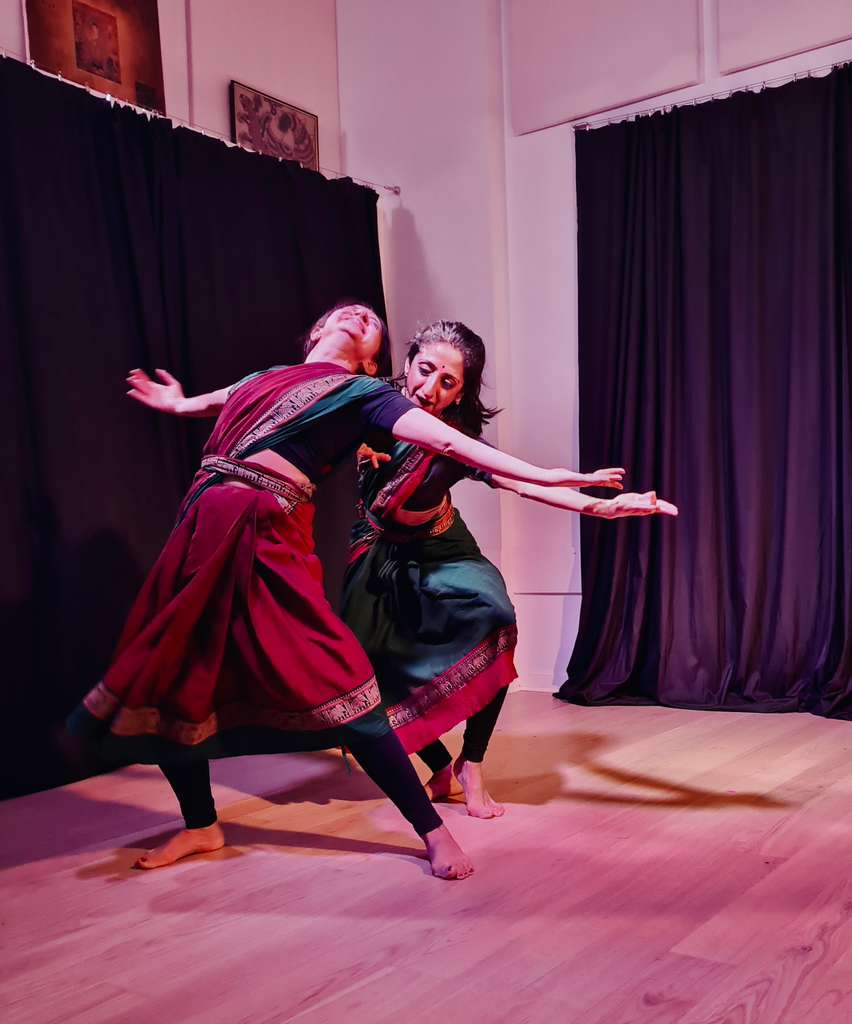
For her first piece, Aditi Dhruv presented a reimagining of Alarippu set in a dance class, performed along with Sonali Skandan, with Bala Skandan on mridangam and Sanjay Cherubala on nattuvangam and vocals. The work focused less on adhering to the choreography, and significantly more on the animosity in the relationship between the friends in class who were learning it. The dancers were pushing each other, chewing gum, pulling each other’s hair, wrestling, showing off, and frankly, barely dancing. While this piece was not technically a solo, it humorously felt like both dancers wished it was.
I enjoyed that the musicians were unwittingly involved in the story, and in the not so friendly human rivalry that probably exists within this very space in which it was presented. Despite this, the genuine friendship between dancers (both on and off stage) was palpable, and truly elicited joy. The audience, which included many students of bharatanatyam, children and adults alike, reacted loudly, with resounding laughter throughout the work. One young dancer near me had remarked midpiece that this was the “best performance ever!,” and it confirmed for me that we turn to art to feel seen and represented. After the piece, amidst a flurry of conversation about how far they had deviated from the traditional form of bharatanatyam, Bala Skandan jokingly reminded us that “I kept my art!” This, to me, feels necessary in experimental work. Whether scientific or artistic in nature, it is important to keep some things controlled (here, the talam/mridangam), in order to allow the variable (here, the scuffle) to be the focus.
Despite the drastically different approach that this piece took from Vandal’s earlier work, I felt that this too had a story so potent that the movement itself did not matter. Just because it was silly, did not mean the artists did not take it seriously – they presented this piece with finesse and clear intention, in a manner which was accessible to the whole audience.
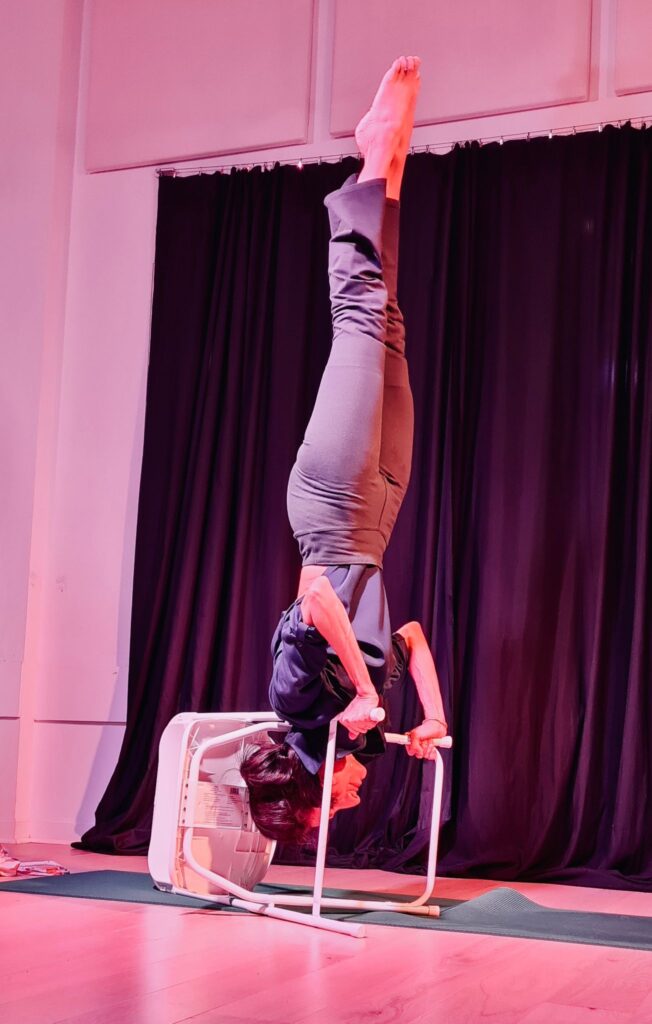
Dhruv’s second piece was a simple ode to waiting and a lament of the hurry and hustle of our lives, inspired by a decades old friend. At the opening of the piece, Dhruv missed the bus, and what unfolded was a yogic/gymnastic movement exploration in duet with the bus bench/chair which asked, “could we maybe even enjoy the waiting?” Throughout the piece, Dhruv was speaking to us with winks and smiles, acknowledging the virtuosity of the strength in her movement. It felt like the joy of somehow hearing a singer’s smile in a recording even without seeing them. This piece resonated with one of my current philosophies: I deeply believe that boredom (as opposed to contentment) is the truest neutral emotional state. Tragically, the second we ever achieve it, we immediately go searching for feeling again. At the end of the piece, in her distraction, Dhruv also missed the next bus.
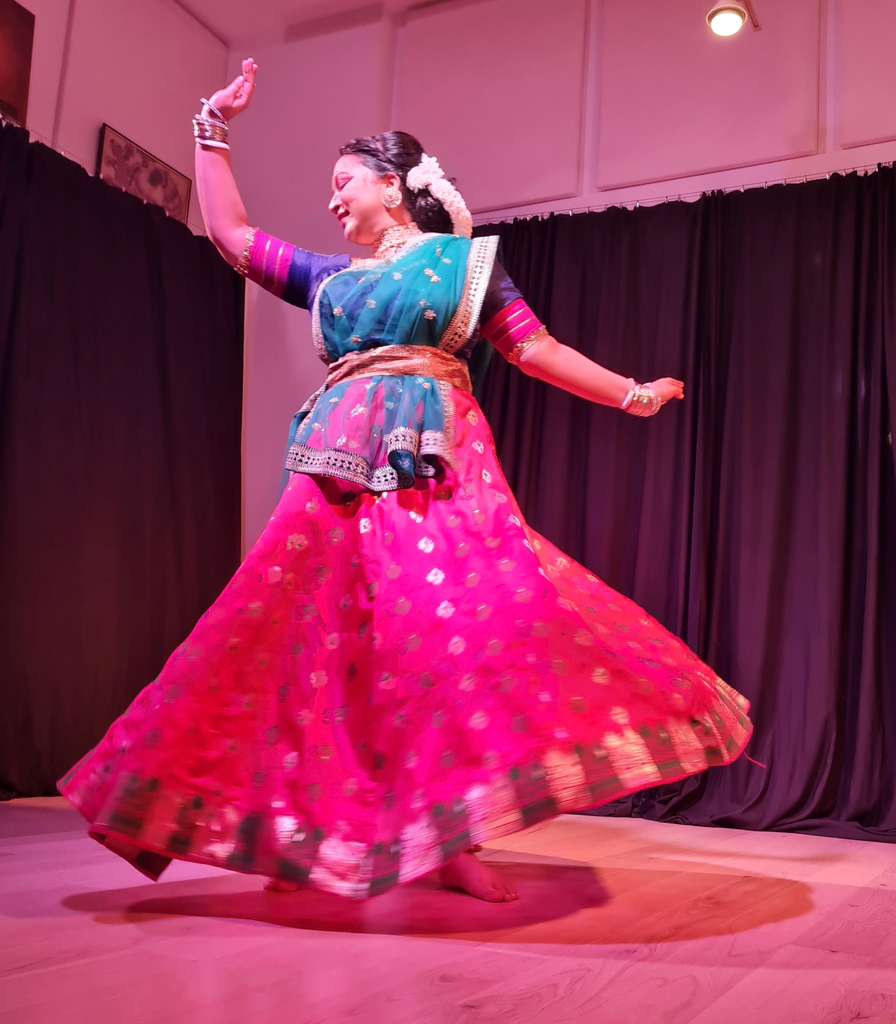
Swarna Roy Shanta presented a traditional kathak tarana, with a story depicting Krishna and the gopis as they dance in Vrindavan. I was immediately stricken by Shanta’s genuine, almost inquisitive smile. Her facial expressions were apt and engaging even through the non-story portions. She commanded the taal with crisp footwork that reverberated up through to her face, and demonstrated deep understanding of musicality as she effortlessly moved through the composition. If visual art decorates space, and music decorates time, I think of dance as a decoration of space and time, and her rendition of this piece felt exactly like that.
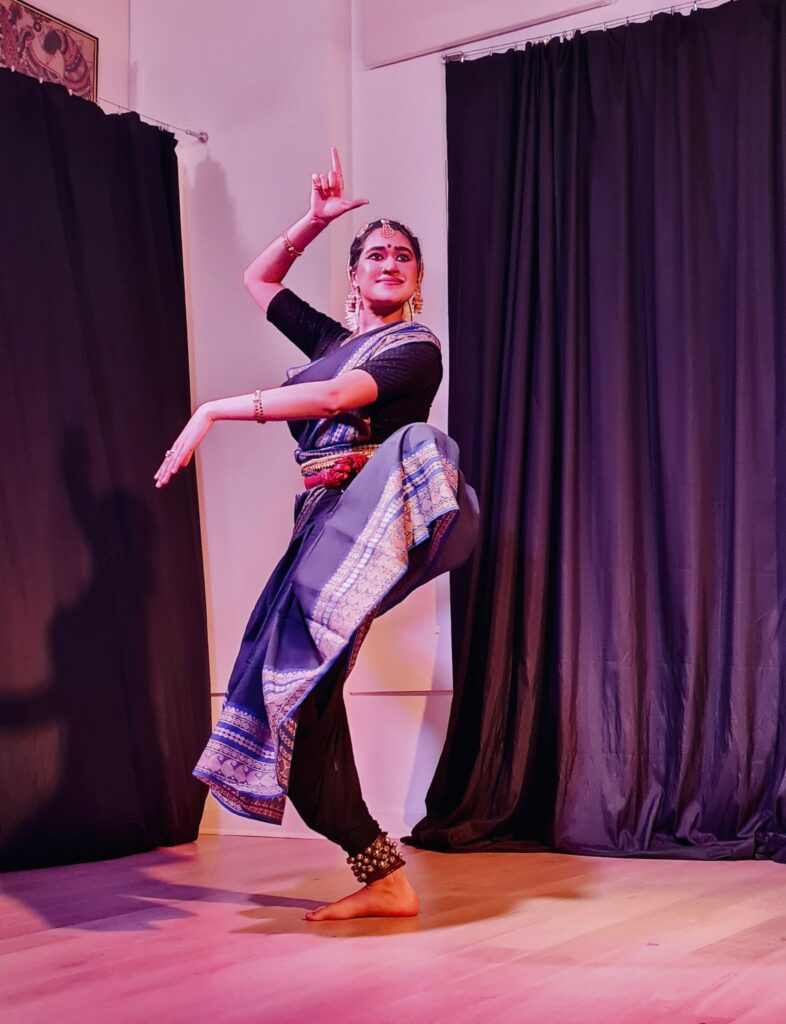
Srividhya Chandamouleeswaran presented a Shiva Stuti, demonstrating a clean, precise attention to detail, and clear dedication to the craft of bharatanatyam. I always enjoy watching and noticing what aspect of form a dancer loves most, because it is clear that they assign the most love to it in their practice. While watching her, it was easy to notice what she values most from bharatanatyam’s aesthetics – deep aramandi, strong natyarambham, clarity in footwork, intentional prepwork, and completion of movement through the end of a line – all which were beautifully visible in her presentation. Chandramouleeswaran is one of those dancers where you could take a photo at any micromoment, and it would come out as if it were perfectly posed.
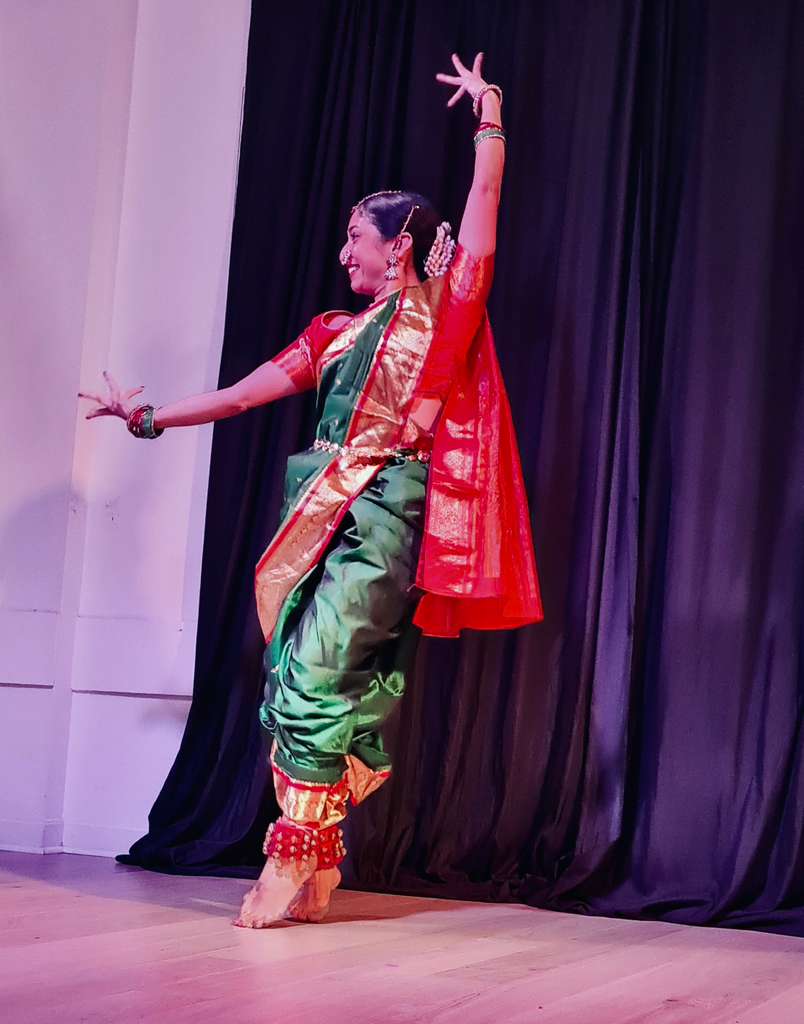
Sunita Chaphalkar presented an upbeat lavani piece in which the nayika is afraid to tell her father she lost her earring in the bazaar. Her movement opened with that particular turbulent bounciness that is signature to the lavani style, then slowed and mellowed upon the commencement of the narrative. Her face was loudly expressive, and her character demonstrated a certain boldness of a girl who’s in trouble, yet somehow unconcerned with it. We learned later that this piece was choreographed by her mother, adapted by Chaphalkar, and now witnessed by her daughters, and Chaphalkar informed us that she always dances for her kids. To me, this took the cheery, light piece to a deeper level, as it became a celebration of maternal lineage, and art as a form of connection.
The afternoon concluded with a Q&A of all the artists, and the conversations floated between themes of tradition vs. experiment, real time improvisation, levity, and internal thought behind practice and performance. I think it is human nature to draw parallels, and despite being standalone works, I found myself synthesizing a connecting thread. Art is multifaceted: there is the skill of art as a craft, and there is the skill of art as a creative practice. With the “traditional” pieces, I felt inclined to observe and comment on the technical prowess, the dedication to the form, and the execution of movement, and for the more “contemporary” pieces, I was more drawn to reflect on the creativity in movement, the deviation from form, and the underlying message. Art meets us where we are!
![Read more about the article MAN[or]GOD – Mavin Khoo & Hector Ferrer](https://pulseconnects.com/wp-content/uploads/2025/11/Review-Man-God-101-ed-300x200.jpg)