Dixon Place, NYC
April 12, 2026
Reviewed by Aditi Dhruv for Line & Verse
Image credit: Nivita Chalika
“Muruga & Kismet with Kali,” presented by Sri Thina Dance at Dixon Place in NYC, offered a powerful and deeply personal exploration of faith. Featuring two solo works – “Muruga” by Sri Thina Subramaniam and “Kismet with Kali” by Shruti Abhishek – the production utilized the Bharatanatyam form, spoken language, and text to showcase worship not as a static ritual, but as a living, breathing identity.
“Muruga” by Sri Thina Subramaniam
“Muruga,” originally conceptualized by Mavin Khoo and O.S. Arun, was reimagined here by Subramaniam, a student of Khoo’s who was part of the work’s original inception. For her, revisiting this piece as a seasoned performer is its own form of devoutness.
The work is inspired by a “distinctly Malaysian” style of devotion to Muruga – one that is intense, joyful, and fierce. The piece opened with video clips of the rituals seen during Thaipusam, providing a visual anchor for the live performance. Subramaniam entered the stage as if stepping directly out of the screen, continuing a spiritual procession that bridged digital memory and physical reality.
What followed was a wonderful interpretation of the nayika’s anticipation of Muruga’s return. She began with a flashback of having offered Muruga freshly churned buttermilk, and bookended the piece with his anticipated return and the offering of another glass of buttermilk. Between these moments was a cleverly woven mala of jathis and sancharis. While the format of the varnam was traditional, this particular composition introduced songs and shifted ragas based on specific lyrical cues. This interplay of thematically relevant songs brought an element of surprise that felt like a “breath of fresh air” for both Subramaniam and the audience.
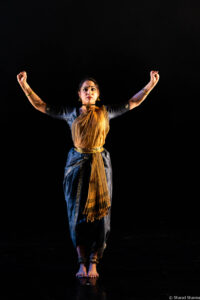
Her performance balanced a range of abhinaya with dynamic technicality. In one charming sequence, she portrayed the nayika cajoling a reluctant, teenage-like sakhi to deliver a letter to Muruga. The sakhi had to be encouraged, coaxed and eventually pushed to get moving, and Subramaniam broke the fourth wall to great effect with abhinaya subtle enough to elicit knowing chuckles from the audience. These light-hearted moments were contrasted by poignant stillness, where Subramaniam stood in a single spotlight, evoking the raw anxiety and joy of anticipation. Her execution of the jathis – some featuring Khoo’s signature style, others tailored to her own form – warranted the spontaneous, enthusiastic applause they received.

“Kismet with Kali” by Shruti Abhishek
In “Kismet with Kali,” Shruti Abhishek explored the architecture of faith through extensive research into Kali temples across India. Guided by guru Vaibhav Arekar and dramaturge Nadhi Thekkek, Abhishek posed fundamental questions: What is faith? Where is it when we need it?
She asked that Kali be a witness to the performer’s identity and idea of “self,” and requested the audience to witness the witnessing, to witness the witnessed. In doing so, she established a powerful triangle of identities – Kali, performer, and audience – akin to the relationship between mother, daughter, and divine energy.
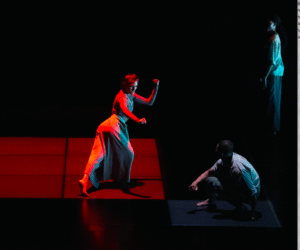
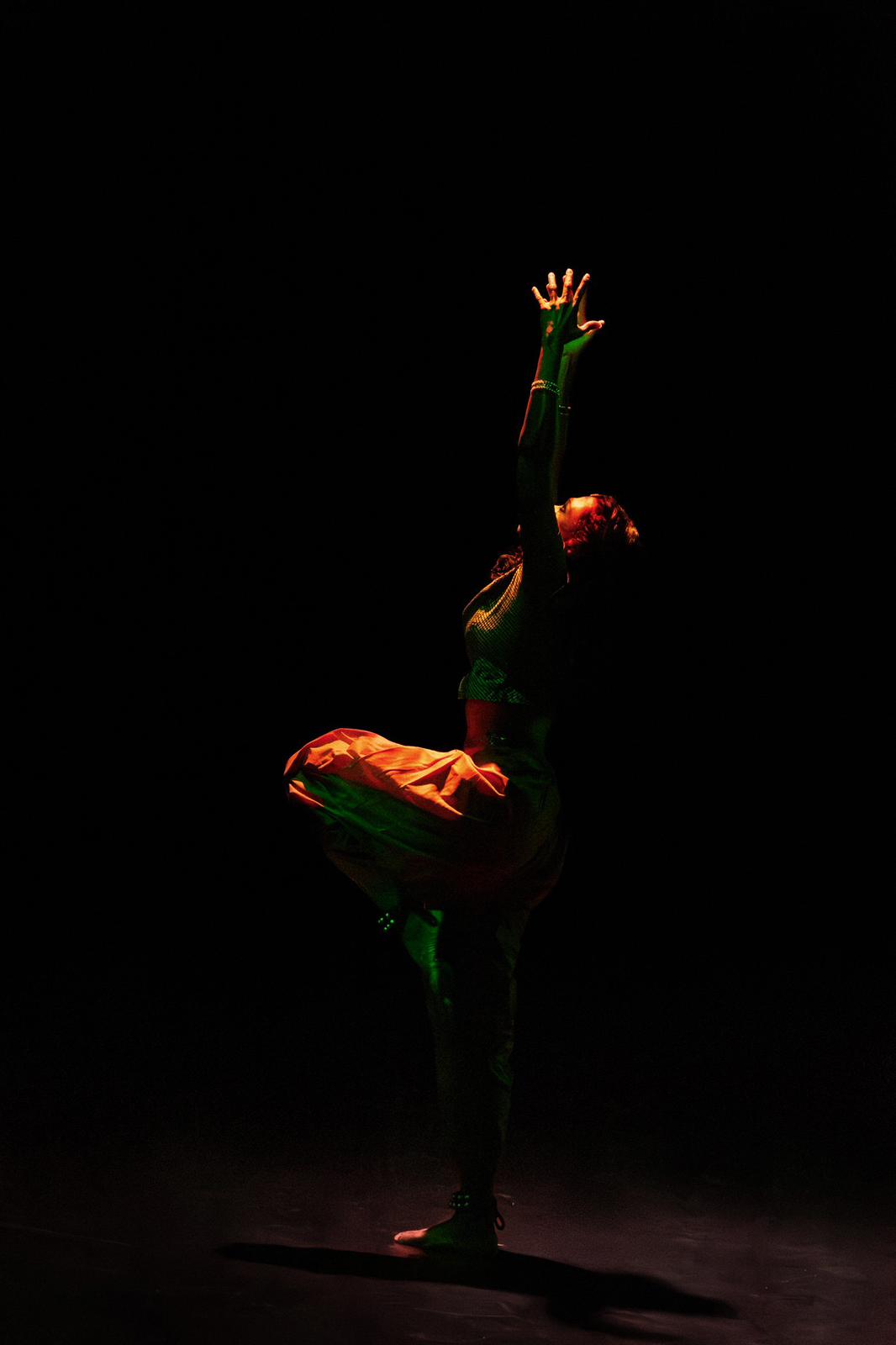
To evoke this, Abhishek intentionally moved beyond traditional boundaries, employing Kathakali and Western contemporary movements set to the sounds of the chenda and thavil. This created a distinct choreographic landscape and soundscape, evoking a visceral experience for the viewer. The soundscape later expanded into the lyrics of the Mahalaya chant by Birendra Krishna Bhadra, a nod to Kali’s cultural roots in Bengal. Guided by music co-directors, Sindhu Natarajan and Karthik Hebbar, Abhishek made a conscious choice to not use lyrics anywhere else throughout the work, allowing the audience to forge a personal/individual relationship with the performance. The lighting shifted from a stage bathed in red to isolated spotlights, heightening the emotional stakes. Following a frenzied peak, a deliberate, extended blackout forced the audience to sit in the uncomfortable darkness and silence – a moment for the “witness” to process the transformation occurring in the dark.
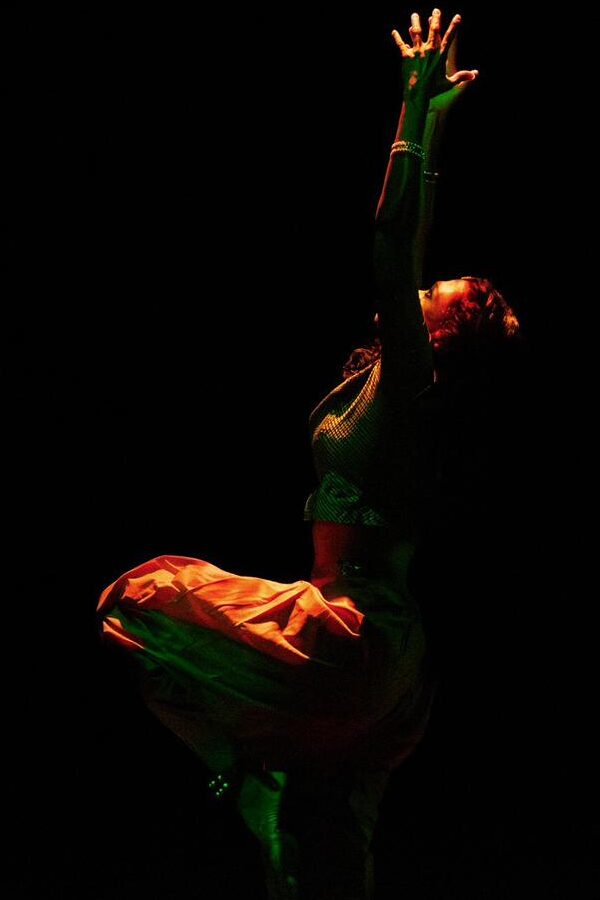
Both dancers are compelling, highly accomplished artists with a shared rigor, immense control, and clean angashuddhi. Their choreography wisely avoided the frenetic, acrobatic jumping currently in vogue, opting instead for a grounded, satisfying physical language. Furthermore, both performances were anchored by a high degree of musical and creative scholarship and input.
Significantly, both pieces were deeply researched and leaned into a bhakti that is raw and unpalatable rather than “Brahminic” or “pretty.” By choosing not to translate the Tamil and Urdu texts, the artists tasked the audience with being active participants rather than mere observers.
Personally, I found myself craving even more of these “non-beautiful” moments – a version of “Muruga” that leans further into brutalist depictions of worship, and a “Kismet with Kali” that offers even deeper initial grounding of identities to further immerse the viewer in an experience of embodied devotion.
Special mention to the tech team of Dixon Place, who understood the ‘feel’ of each piece and created appropriate light designs that amplified the visceral impact of the choreography.
The ultimate success of the evening was written on the faces of the audience. In an age of short attention spans, the room was remarkably still. There wasn’t the rustle of feet from restlessness, or looking at the program, or the shushing of younger audience members. Even the youngest children, their feet in light-up shoes not yet reaching the floor, were wholly absorbed.
Overall, this was a powerful evening. Two intelligent and strong dancers paired on a single stage, portraying two very different versions of devotion. While already deeply impactful, the further refinement of these works – leaning even more boldly into their rawest, most visceral elements – promises to make future iterations even more formidable. “Muruga & Kismet with Kali” was both a balm for the eyes and a task for the soul. By making the audience work to navigate the layers of devotion, both performers allowed us to arrive at an ineffable understanding of our own human relationship to the divine.