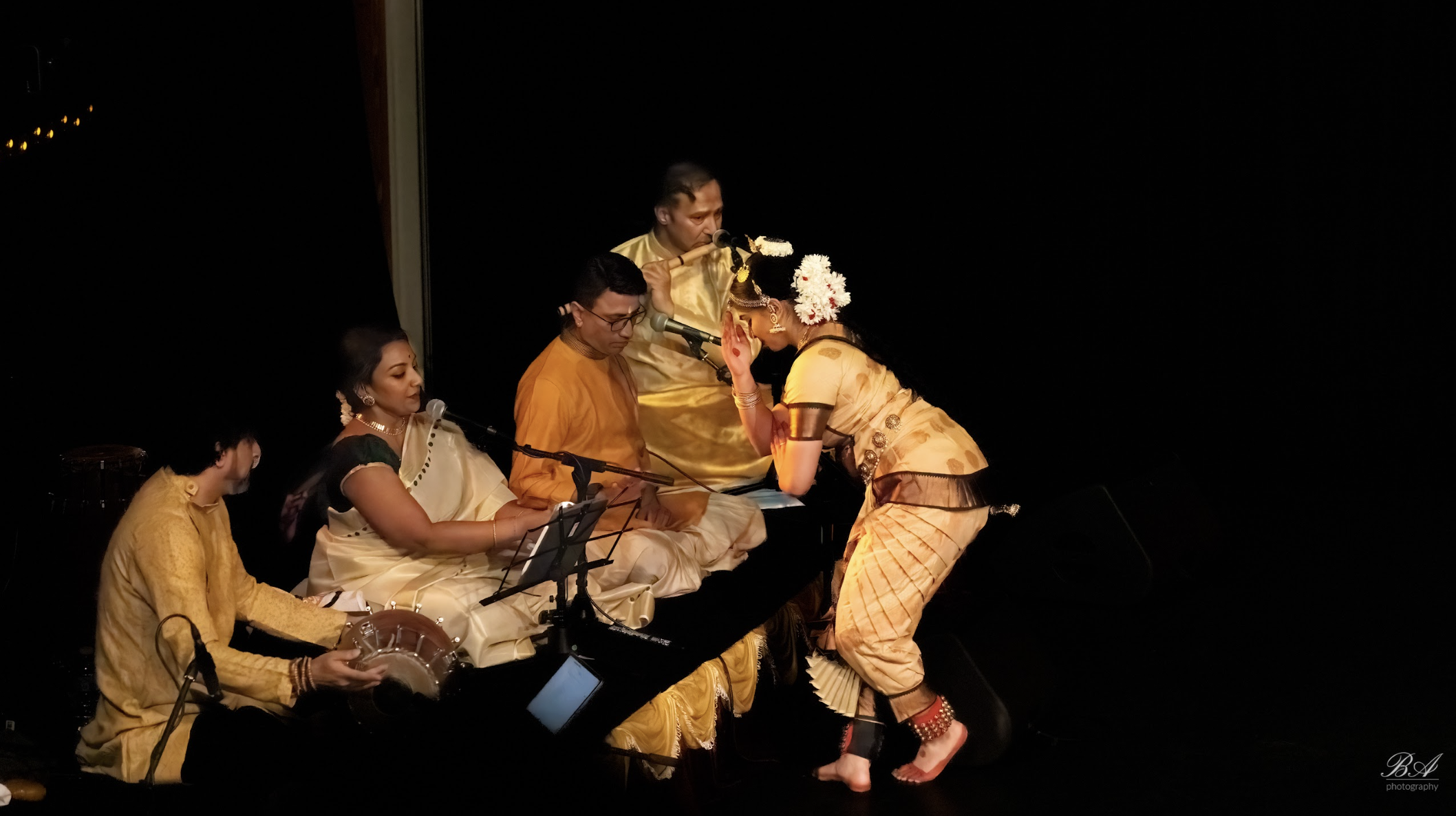
Image credit: Bheem Adavikolanu
Image featured: Prathap Ramachandra, Amritha Jayakrishnan, Vanshikrishna Vishnudas, Vijay Venkat; dancer-Anjali Sivanandakumar
Ranjini Nair, kuchipudi artist and dance scholar visited the community-led platform that addresses the lack of opportunities for full length classical dance performances in London and the UK. She examines what makes the two-day event unique.
As I made my way on a sunny March Saturday to the first edition of London Margazhi, I carried excitement. What does this new South Asian dance festival offer the dancer? This broad question carried alongside excitement. It felt important because, while South Asian dance is not exactly mainstream in the UK, it has built a clear and undeniable presence in the sector, making this a moment ripe for new interventions. Within this landscape, London Margazhi emerges as a novel and ambitious foray, led by London-based Bharatanatyam dancer and ex-management consultant Amritha Jayakrishnan, seeking to create a new and different space for South Asian dance and its practitioners. The festival builds on her sustained work over the last six years building community for bharatanatyam dancers in London via London Adavu, a space for peer-led dance practice.
Here’s what made this two-day dance festival unique from the outset. First, all logistics were covered by the festival, ensuring dancers are paid fairly; still a rarity, especially for the long-form margam format. Second, the festival championed the long-form margam presentation in the UK, which is otherwise uncommon unless dancers independently hire venues and self-produce. Finally, and perhaps most importantly, the festival offered mentorship, artist development, and a sense of community to participating artists. The selection panel, including dance stalwarts like Vidhya Subramanian and Mavin Khoo, also provided mentorship to the dancers and their own mentors. The selected artists worked with some of the most experienced musicians in the UK, while also opening doors for emerging talent.
…’the festival offered mentorship, artist development, and a sense of community ‘
The festival also included a daytime programme, ‘Margazhi Mela,’ on both days, offering a more accessible entry point for those less familiar with a margam. Highlights included curtain-raiser musical acts by young artists; panel discussions on “art and life” featuring practitioners and industry voices such as Seeta Patel, Divya Ravi, and Meenakshi Ravi; interactive craft workshops; stalls by South Asian–owned small businesses; and an Arts Hub networking table for UK arts organisations.
Was the naming of London Margazhi a nod to the well-known dance and music season in the Tamil month of Margazhi, or a reframing of what Margazhi could be? Perhaps both, according to Amritha Jayakrishnan, founder of London Adavu and London Margazhi. For her, Margazhi evokes a “time where art becomes central to everyday life,” as it does in Chennai and across India. At the same time, she was clear that she did not want mere replication. Instead, her aim was to “create that same sense of immersion and collective energy here in London”, while also looking to fill a glaring gap in the sector. Crucially, Jayakrishnan wanted to build something that went beyond a simple performance platform, prioritising mentorship, artist development, and deeper engagement with the process of performance.
…’commitment to long-format presentation‘
She also emphasises London Margazhi’s commitment to long-format presentation, which is an opportunity largely missing from other South Asian dance festivals in the UK. Kavya Iyer, one of the festival’s dancers, underscores this while reflecting on her experience. What made London Margazhi unique, she says, was the time afforded to the dancer both on and off stage. Three months of preparation with mentors, musicians, and choreographers allowed the margam to truly blossom in performance. Adithi Ravi shares a similar view, calling the festival “a standout” for bringing the margam format to London, “where it is very rarely seen,” with the opportunity to perform alongside a live orchestra as “the cherry on top.”
Speaking further on how London Margazhi diverges from its namesake in India, Jayakrishnan notes that she did not want the stage to be the end goal for dancers. Instead, she aimed to ensure that each dancer is treated as a paid artist, supported in building a sustainable career—something still notably absent from many Margazhi platforms in Chennai. Rather than shouldering the financial burden of performance, dancers here were fully supported, with costs for musicians, mentorship, and rehearsals covered by the festival.
The dancers also spoke about how the experience reshaped their relationship with their practice. Rajeswari Ramaswamy reflected that London Margazhi gave her the time, space, and motivation to return to her work with “more personal intention and understanding,” alongside the opportunity to collaborate on a new varnam, which she described as a “great learning experience.” Kavya described rediscovering her relationship with the form “in a more democratic way,” feeling reassured that she “could give the margam a voice of my own.” For her, the realisation that the traditional format could accommodate experimental work was a serendipitous outcome of the process. Adithi similarly spoke of gaining greater “curiosity and clarity” in her practice, noting that revisiting the margam after a long gap prompted her to reflect more deeply on how and why she communicates through dance, refining the nuances of her performance.
…‘a collective endeavour, with dancers and mentors sharing everything..’
A word that recurs throughout these reflections is community. Beyond being a performance platform or artist development initiative, Jayakrishnan envisions London Margazhi as a community space: a bridge between different parts of the dance ecosystem that do not always intersect. This vision appears to have resonated with participants. Kavya describes the process as a collective endeavour, with dancers and mentors sharing everything from “jewellery to jathis,” and learning from one another’s rehearsals. The accompanying Mela, she adds, was a reminder that dance extends beyond the individual performer, prompting reflection on who and what else might be included in this ecosystem. Adithi echoes this, noting the support not only from individual mentors but from a wider community cultivated through London Adavu, with dancers attending rehearsals and offering feedback. Rajeswari sums it up by emphasising how welcoming and collaborative the festival felt throughout. Much of the organisation was led by a dedicated group of volunteers, and Jayakrishnan is clear that the festival would not have been possible without this team of women who shared her vision and brought it to life.
In a welcome development , the festival received Arts Council Funding in the week prior to its launch; demonstrating its place in South Asian dance landscape. Looking ahead, Jayakrishnan hopes to deepen, not just expand the idea of what a long-format South Asian dance festival can be. On the day I attended, all four dancers were confident and composed, demonstrating both ease and depth in their engagement with movement and music. Their performances pointed not only to the wealth of talent in the UK, but also to what becomes possible when time, resources, and mentorship are meaningfully invested.