
By: Sanjeevini Dutta
The Japanese film ‘Kokuho’ is currently playing in mainstream cinemas and I was lucky to stumble upon it. It blew me away, not only for the riveting plot, excellent acting and cinematography, but also for the fact it held up a mirror to the classical art forms that have been a part of my life for many decades. The film revealed the beauty of the ‘slow arts’, those that require patience and dedication to acquire and equally a practiced eye to appreciate and enjoy.
The storyline is based on the rivalry of two kabuki actors, oonagata (males who play female roles), one who is the son of the kabuki master and his ‘adopted’ brother, whose natural talent had caught the master’s eye. Orphaned when his yakuza father is killed in a shoot-out, the boy is taken in by the kabuki family, not without resentment, and a train of events is unleashed as the two boys vie for the coveted place of number-one. Family ties and relationships are strained to bursting.
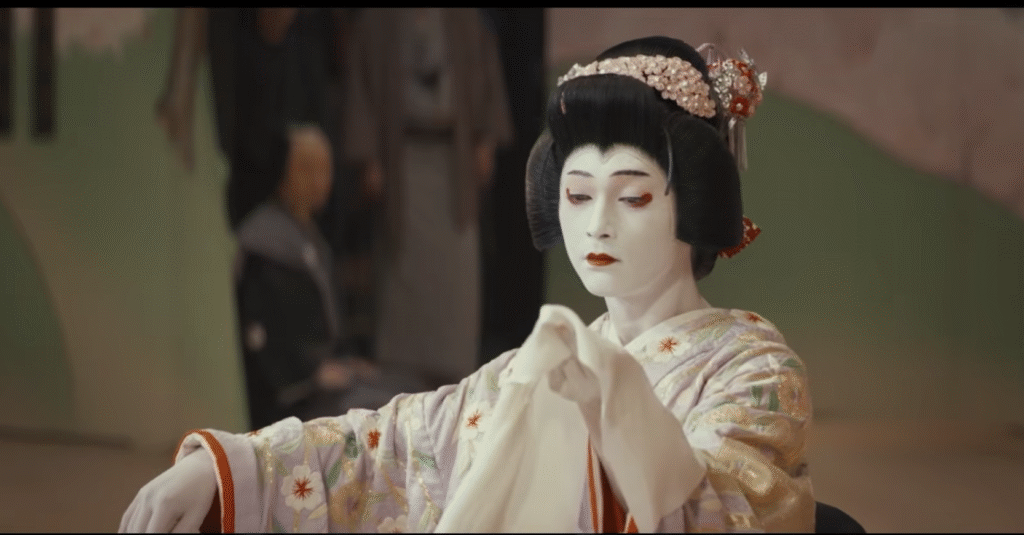
Within the story, the audiences are treated to long performance sequences that convey the power and the magic of this art form that originated in Kyoto, Japan in the seventeenth century. Its parallels with kathakali jump out, both forms of extremely stylised dance theatre that emerged around the same time. However, the connections that I observed serve for all forms of classical dance, with kathkali being the most obvious.
Kabuki is natya, a theatre form in which the plot is conveyed through voice, movement and dance, musical accompaniment, lighting and set design. It is total theatre. The themes are epic, with love and death writ large. The heightened emotions are nevertheless played with gesture and bodily movements which have been ingrained, repeated, over and over again, in the studio. ‘Your muscle memory will come into play when you do the part’, the teacher tells the nervous actor before he goes on stage. The training regime is long and intense –the body broken into to manipulate the arrangement of limbs (think araimandi, chouka and tribhangi).
The dance is at one level very rigid and stylised. There is no room for improvisation or individuation. The stories are simple: a jealous woman, for example, metamorphoses into a snake, or a dance in praise of wisteria blossoms. Yet, strangely, the dance sections are entrancing. To watch dancers gliding across the stage in a highly refined shuffle, is not different from appreciating a skilled odissi dancer’s sinuous meena chali (fish walk) or the ‘moonwalk’ of Michael Jackson. The weight of emotion within the hand movement of the dying ninety-year kabuki master who requests the young artist to dance for him is deeply moving. It is a highly practiced, embodied gesture.
Another of the joys to be savoured are the elaborate costumes with intricate designs: colours ranging from bright vermilion to soft ivory of the kimonos; the sheen of satin; the accessories of delicate fans and umbrellas – these are all an aesthetic experience in themselves. I am reminded of bharatanatyam silk costumes with fans that open as the knees rotate outwards (magical, only if our eyes were not so accustomed).
Finally, the abhinaya, conveyed through the voice, the body movements and the facial expressions, completed the experience of rasa. The terms we use in Indian classical arts precisely reflect how I received the performance: angika: the stances in holding positions and the chalis or the moving in spaces; vachika the use of the voice, ‘The next chime of the bell will be the last we hear’ says the doomed heroine to her lover in the suicide pact; aharya already discussed and satvik the identification with the pure emotion without anything extraneous.
There are unforgettable sequences of the magic of stage – the trembling of the lovers, the other-worldly aura of the white painted faces, human and yet not human. The sheer majesty of the theatre seen angled downwards from the Gods, the specs of light and star dust that rain down, the shape of the weeping willow set on the third of the stage.
On the one-side is the artform and its practitioners but equally it is the funders, the theatres and ultimately the audiences that are needed to uphold the institution. From the film we sense that kabuki has a following amongst the middle and upper classes. A far-cry from the time it was performed in red-light districts where there could be a genuine mix of social groups. In the film, the head of a large corporation is a kabuki buff and major donor. Considering a three-tiered theatre is fully booked one imagines that there are enough followers. Significantly when the out-of-work actor must survive by playing in restaurants and at parties, his skill is unseen and he is kicked and bashed for being ‘queer’. Is it a case of ‘casting pearls before swine?’
This raises a very pertinent question of how the dance we present is framed. Classical dance needs the formality of a ‘sacred space’ being created even if by an introduction and providing a context. When left without ‘formalising the occasion’, audiences do not know how to read it.
Finally, the concluding remark from the daughter of the protagonist who has watched her father from a distance, ‘You hurt many people on the way to the top. But every time I watched you on stage you took me to some place. I was transformed’.
That is what we dancers and actors live for to be that vehicle of transcendence. I am deeply grateful to the director Sang-il Lee who envisioned this film. In the era of short attention spans this is a two and half hour film of great slowness and utter beauty.
Note on the film: Kikuho was Japan’s official entry at the Cannes Film Festival in May 2025, and was released in Japan on 6th June 2025. It has been a huge box-office success, evoking national pride in the country’s classical arts and introducing kabuki to the younger generation.