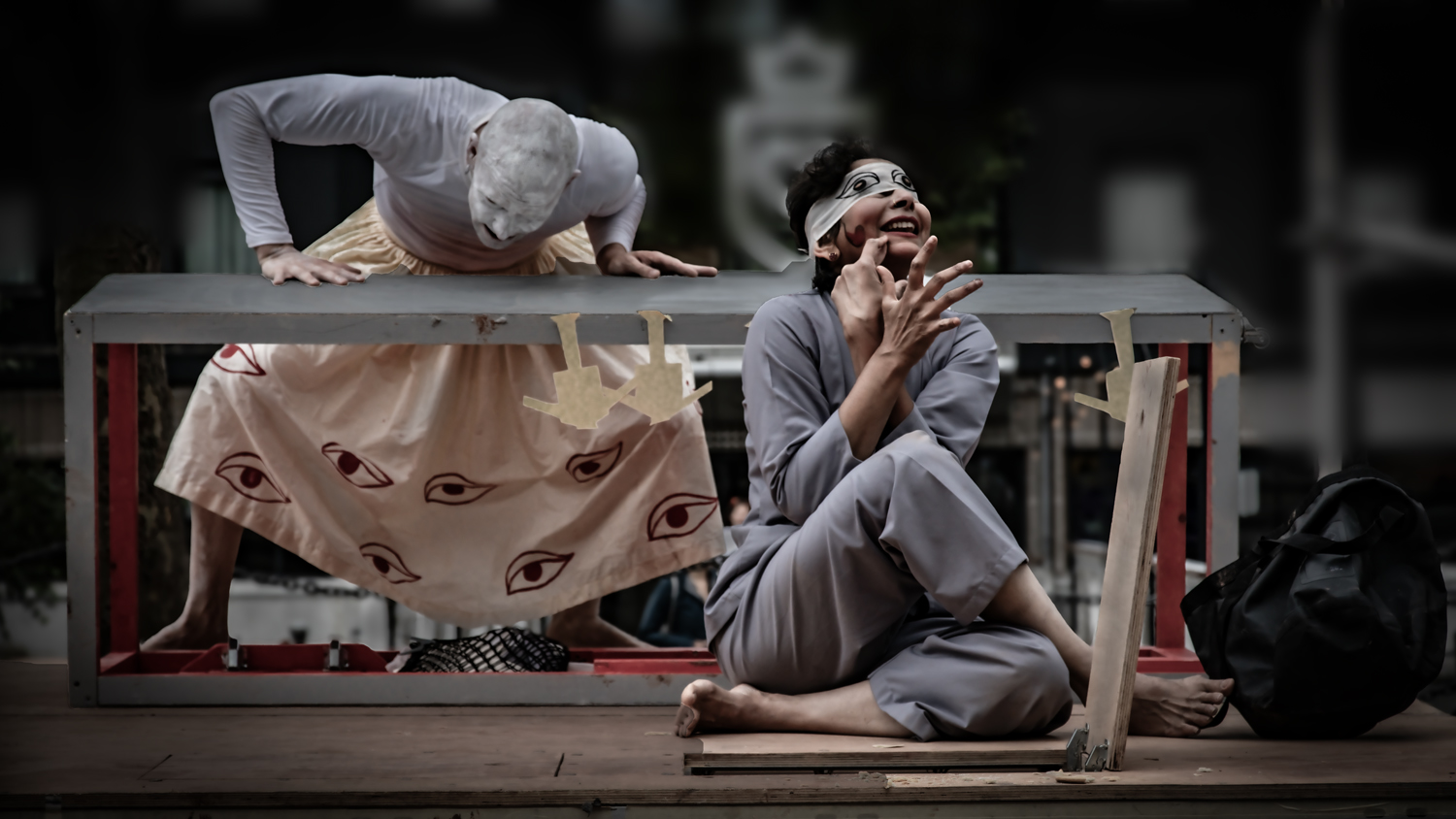
Image credit: Robert Golden | Featured: Sasha Krohn and Vidya Thirunarayan
Dance artist and ceramicist Vidya Thirunarayan reflects on how art works reveal themselves by the quality of the attention we give them.
Some lines do not simply pass through the mind; they settle and return, asking to be understood more fully. This morning, it was an opening phrase from a Tamil kīrtanam that I found myself humming:
Kaana kann koti vendum — one needs a thousand eyes.
Written by Papanasam Sivan in the early 20th century , the line gestures toward a way of seeing that exceeds the ordinary. Not just looking, but a deepened receptivity — the sense that what is before us cannot be grasped all at once, and perhaps not even completely.
It brings to mind a line once shared with me in an email by Jason Wason, the Cornish ceramicist:
“Many people can talk the talk, but the subtle understanding of the subject in hand is more elusive than that. Only the works reveal the understanding, for those that have eyes to see.”
There is, between these two voices — distant in time and place — a quiet resonance. One speaks through devotional poetry, the other through the language of making. Yet both seem to circle the same insight: that seeing is not guaranteed, and understanding does not arrive on the surface.
We often assume that to see is to know. But certain encounters — especially with art — gently undo that assumption. They ask us to slow down, to return, to remain with what is not immediately clear. What reveals itself does so gradually, almost in response to the quality of attention we bring.
At times, this becomes apparent in how certain works sustain repeated viewing. The dance dramas of Rukmini Devi Arundale offer one such example. There is a clarity and quiet radiance in her choreography that continues to hold attention. Even in revisiting, one senses there is more to be seen than what first meets the eye; something in the work seems to unfold over time, rather than present itself all at once.
In a different register, the work of the Cornish ceramicist carries a similar inwardness. Whether in clay or bronze, there is a restraint that resists quick comprehension. These are not works that yield themselves immediately; they seem to gather presence in proportion to how they are looked at.
Across such experiences, a pattern begins to emerge. The work itself remains unchanged, yet what we perceive within it shifts. Details come forward. Relationships clarify. What once seemed simple begins to feel layered, even quietly profound.
It is as though seeing itself has degrees.
Perhaps this is what is contained in that image of “a thousand eyes.” Not an excess, but a refinement — the ability to look without haste, to stay with something long enough for it to disclose itself in its own time.
There is also, at moments, a subtle reversal. One has the sense not only of looking at the work, but of being met by it. The encounter becomes less about observation and more about presence — something shared, however briefly, between what is seen and the one who sees.
And this may be why certain works remain with us. Not because they have been fully understood, but because they have not. They continue to hold something back, quietly inviting us to return.
To see, then, is not a single act, but an unfolding.
And perhaps that is what it really means to need a thousand eyes: not to see more at once, but to keep learning how to see.
Note
Works by Jason Wason are held in the collection of the Victoria and Albert Museum, London.
Vidya is a performer, researcher, and ceramicist whose practice brings together movement and material inquiry. Her recent work Holy Dirt will be presented at the Norfolk and Norwich Festival (9 May) and the Brighton Festival (23–24 May).