Bharatiya Vidya Bhavan,
New York City
14 February 2026
Reviewed by: Shiva Kannan for Line & Verse
It’s 6:15 pm on Valentine’s day in Manhattan, and the seventeenth floor of 305 Seventh Avenue smells like masala chai. The elevator opens into the familiar warmth of the Bharatiya Vidya Bhavan, USA, where a handful of early arrivals cradle paper cups and settle into their seats as the sound of Pandit Nitul Banerjee’s bansuri drifts through the room — a recording of Raag Bageshri, unhurried and full of evening tenderness, setting a tone the rest of the night would build upon.
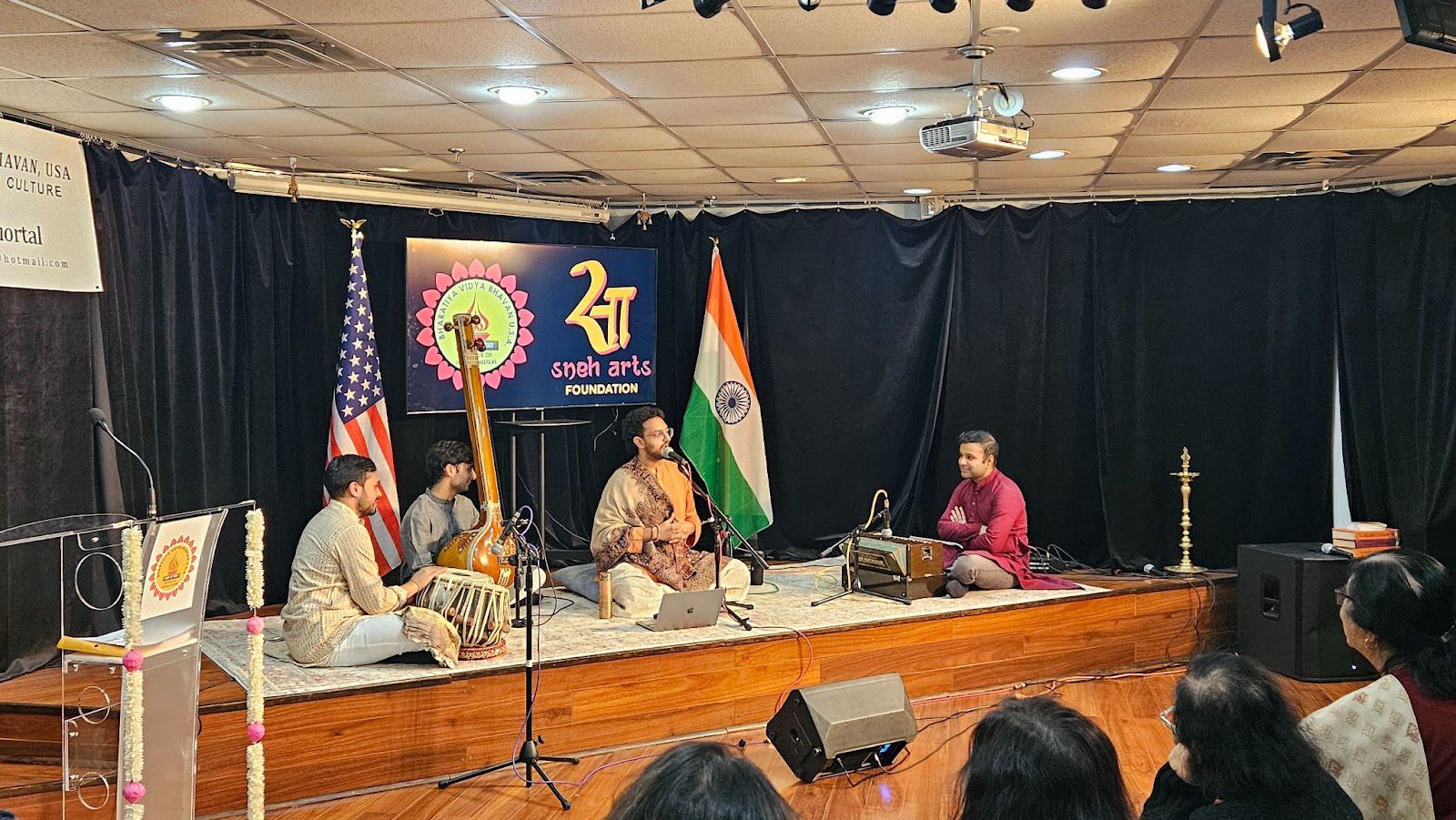
Presented by Bharatiya Vidya Bhavan, USA and Sneh Arts Foundation, and curated by Sunny Thakkar, “An Evening with Artists from the Diaspora Generation” brought together young Indian classical musicians from across traditions.
The Opening: Tanisha Srivatsa and Siddharth Ragavan
The evening opened with a Carnatic set by violinist Tanisha Srivatsa and mridangist Siddharth Ragavan, both artists of the very diaspora the evening sought to celebrate. Tanisha opened with Enna Thavam in Raag Kaapi, a Papanasam Sivan composition steeped in devotion, and a raag(am) that carries the fingerprints of Hindustani music within its Carnatic framework, a fitting choice for a night that would bridge both traditions.
What followed was Kamalapta Kula, a Thyagaraja kriti in Brindavana Saranga. In an instrument-only setting, the line between composed phrase and improvised flourish can blur for newer listeners, and given the evening’s diverse audience, a more expansive alapanai, or a brief introduction might have helped ground the uninitiated. That said, the swarams themselves were playful and engaging.
The next piece, a Thillana in Sindhu Bhairavi composed by Lalgudi Jayaraman, was where Siddharth Ragavan came fully alive on the mridangam. What stood out was how thoroughly he knew the composition, every phrase, every turn — which is not always a given for percussion accompaniment. That familiarity showed: the Thillana filled the room with just the two of them on stage. And then, what should have been the end of the set became its most quietly powerful moment.
At Sunny Thakkar’s request, Tanisha took up one more piece, unplanned, unrehearsed — a composition in Kedaram called Nataraja Murthe, written by her great-grandmother, Saraswati Ammal. Here was the diaspora generation not just interpreting the masters but reaching into their own family lineage, pulling a composition across generations and oceans, and presenting it as living music. A day before Shivaratri, a Nataraja composition carried a particular weight, whether by design or happy accident, the timing felt right.
Akhil Jobanputra: Love, Through a Hindustani Lens
After the Carnatic half warmed the room, the second half shifted terrain entirely: how does love live inside Hindustani music?
Vocalist Akhil Jobanputra, accompanied by Tejas Tope on tabla, Rohan Prabhudesai on harmonium and Aditya Phatak on the tanpura, took the stage and did something deceptively simple Before singing a note, he introduced his first three pieces. In Akhil’s words: “the first three pieces were a progression from unwanted love to trapped in love”. Once the music began, there was no need to pause and re-explain, no break between compositions. The room knew where it was going, and could simply listen. The raag for the first three pieces was Maluha Kedar. With Akhil’s rendition, the raga’s emotional character, its mood and its colours made it clear why it was chosen to tell the story.
The first two pieces, Achara Mora in Vilambit Teen Taal and a Madhya Laya composition by Pt. Ramashray Jha — worked as a pair, both lending themselves beautifully to searching through the melodic space of the raag, where the act of finding the beauty of each phrase mirrored the complexity of love itself as an emotion. The vilambit lay piece, which is a slow paced composition, gave the room sixteen easy beats to breathe, while the madhya laya quickened the pulse without losing that exploratory quality.
The third piece, a Drut Laya bandish from the Agra Gharana, brought the progression to its emotional peak, love songs about Krishna, a friend confiding to another about how Krishna had quietly stolen her heart. Rohan and Tejas both delivered fine flourishes here, and one couldn’t help but feel that the programme might have benefited from giving them more room to improvise. That said, what Tejas offered within that space was striking: his sync with Akhil’s improvisations was so precise, so instinctive, that spontaneous melodic turns were met in real time, making the unplanned sound rehearsed. That kind of synchronicity is not easily arrived at.
The fourth piece shifted from the divine to the deeply personal — an original composition by Akhil in Jayjayvanti, written for a friend who was leaving the city. As Akhil framed it, love in friendships is no less significant than the romantic kind, if not more so. Jayjayvanti carried that weight beautifully, the raag’s natural pull toward longing and heartache gave the composition a quiet ache that needed no explanation.
The evening closed with a Thumri — Banao Batiyan in Mishra Bhairav, set to Dadra taal, and if the audience expected the night to end on a tender note, Akhil had other plans. The subject was love’s most dramatic chapter: love gone astray. A fitting choice for the Thumri form, which has always made room for exactly this kind of high drama. The room broke into laughter the moment Akhil explained what the final piece was about. What a way to close!
A Quiet Valentine
“Opening acts” are not a convention in Indian classical concerts and that is precisely what made this programming choice so refreshing. It gave emerging artists a stage to grow into, and it gave the audience time to settle in and attune their ears. After the concert, Akhil mentioned that Hindustani music holds a wealth of compositions about friendships and the love within them — pieces that often go unperformed. Evenings like this one, that bring those compositions to light, deserve a bigger audience and a bigger stage. The quality of musicianship on display, from both halves of the programme, more than warrants it.
The night of Valentine’s day, in a seventeenth-floor room in midtown Manhattan, love took many forms — devotional, romantic, dramatic, inherited. And every one of them felt earned.
Photo Credits: Sneh Arts & Bharatiya Vidya Bhavan