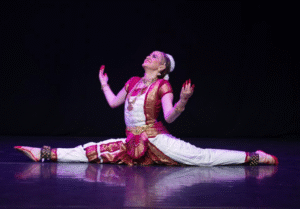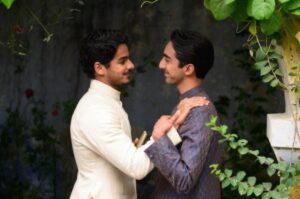
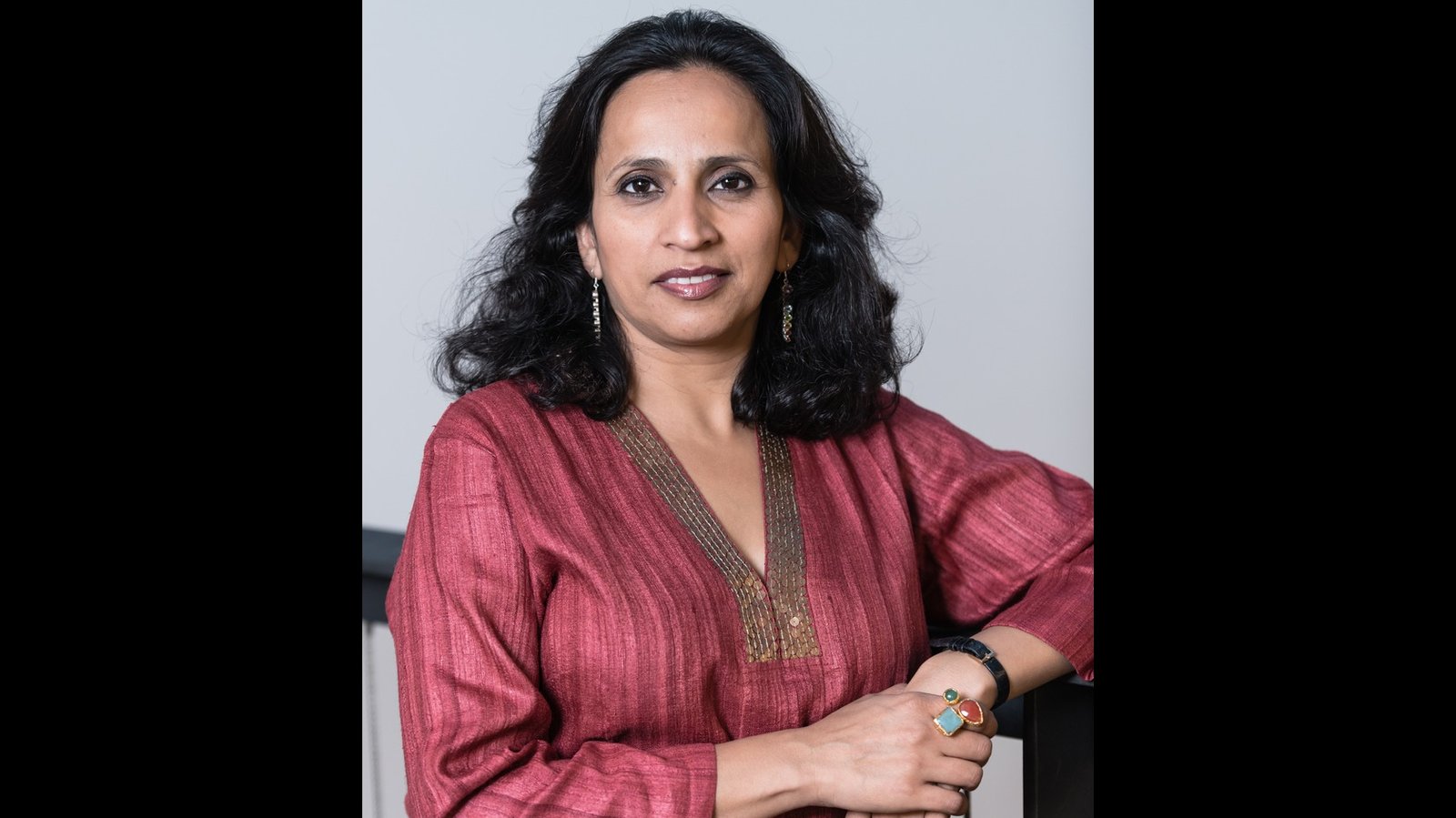
Urja Desai Thakore, Artistic Director of Pagrav Dance lays bare the questions and puzzles that need to be solved in the making of the company’s new production Khoj– The search. She invites the readers to ponder the same questions.
Image credit: Dance Northwest
Khoj began with a desire to question how Kathak bodies and perhaps more broadly, South Asian bodies are perceived.
What do audiences expect when they see a South Asian artist walk onto a stage? What do they expect from a Kathak dancer? How much are we allowed to move beyond those expectations before our work is no longer recognised as the artform we say it is?
These are questions that have been sitting with me for some time.
There is also something I have become increasingly curious and sometimes frustrated about: the desire to understand everything. With Indian classical dance, there can be an expectation that every gesture must be explained, every reference translated and every meaning made accessible. We are often asked to provide audiences with the tools to understand the work before they have even experienced it. I find myself questioning why. Can an audience simply experience a gesture without knowing exactly what it means? Can they encounter something unfamiliar without being spoon-fed an explanation?
Alongside this sit more complicated questions around appropriation and the way culturally specific artforms can sometimes be treated as boxes to be ticked. Who is allowed to take from an artform, transform it and call it contemporary? And who is expected to remain recognisable, representative or ‘authentic’?
I didn’t want to explore these questions by making a work that simply tells an audience what to think. This is one of the reasons I was very keen to work again with visual artist Hetain Patel.
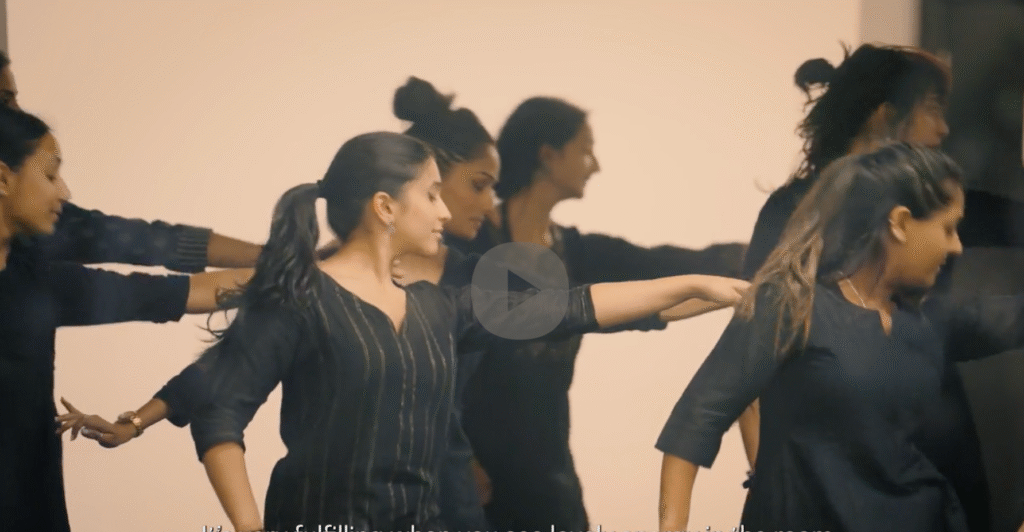
Images: Company trailer
Hetain has an ability to approach complex questions around identity, culture and perception with humour. I have always admired that about his work. Humour can expose something without immediately explaining it; it can make us laugh and then, perhaps a moment later, make us question why we laughed. Finding that quality within dance and particularly within kathak is much harder, and that challenge really interested me.
Hetain also brings his particular approach to working with text. In Khoj, we are exploring how spoken word can exist alongside the physical language of kathak not necessarily to explain the movement, but as another layer within the work. This feels especially interesting in a piece that is questioning our desire to have everything explained. How can we use words without the words becoming an explanation? How can text, movement and image sit alongside one another, sometimes supporting each other and sometimes creating friction?
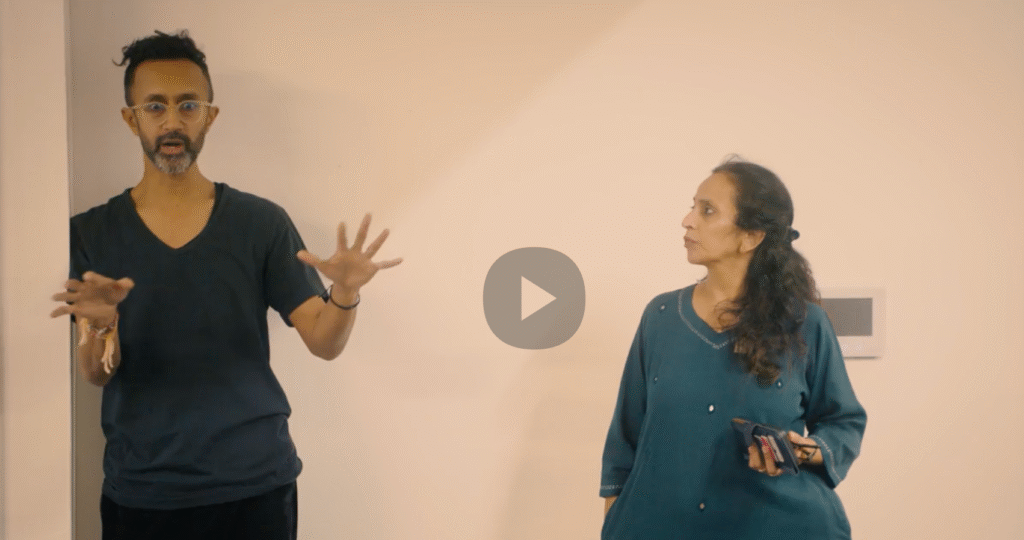
Hetain and I have collaborated before, and our previous experience of working together was remarkably smooth. This time, perhaps appropriately, it has not always been so. We are disagreeing more.
Strangely, I think this is becoming an important part of Khoj. We are both questioning the work, and sometimes each other. Our different artistic practices mean that we don’t necessarily arrive at the same solution, or even always see the same problem. That can be challenging, but I am beginning to see that the friction is keeping the work alive. It is forcing us to interrogate our choices rather than settle too quickly.
For me personally, this has also meant reflecting on my own collaborative process. As a choreographer and Artistic Director, I am accustomed to holding a particular kind of responsibility for the work. Khoj is asking me to make space for another artistic language to genuinely influence and sometimes disrupt my own.
That conversation extends across the whole creative team.
Music is another area where we are exploring a different kind of challenge. I have worked with composer Alap Desai for many years, and his instinct and musical language can often be very cinematic. In our previous collaborations, I have frequently found myself asking him to pull back to be more minimal and to leave space for the movement. With Khoj, I find myself asking for both. I want the scale and emotional landscape that his cinematic approach can bring, but also moments of restraint and minimalism.
At the same time, we are exploring how music can work with Hetain’s approach to spoken word, while drawing from both Indian and Western classical traditions. It is a complex brief: to create a musical world that can move between scale and intimacy, between different classical traditions, and between music, movement and text, without one overwhelming the other. I know I am asking a lot of Alap, but I also believe that this tension is where something new can emerge.
Costume and design are equally integral to this exploration. We are working with Eleanor Bull, an award-winning costume designer whose recent work includes Poor Things, winner of the Academy Award for Best Costume Design. From the beginning, we have been interested in moving away from the idea of costume as something that simply dresses the dancer. Instead, we are exploring a world in which costume can become set, and set can become costume. The materials around the dancers have the potential to transform their bodies, restrict them, reveal them or reshape the space they inhabit. This makes costume an active part of the choreography rather than something added once the movement has been made.
It also creates another interesting challenge: how do twelve moving bodies, text, music and a constantly transforming visual world coexist without becoming too much? The scale of Khoj makes all of this particularly ambitious for me and for Pagrav Dance Company. Working with a large ensemble of dancers changes the possibilities of Kathak on stage, but also the complexity of making it. We are thinking about how individual bodies are perceived, but also about what happens when those bodies become a collective.
At times, the process feels exciting. At other times, enormous. But perhaps that is what Khoj needs to be. The word Khoj means a search or a quest, and at this stage of the process, that feels particularly true. We are still developing the work. We don’t yet have all the answers and I don’t think I want us to. That is part of the Khoj– the quest…