How young contemporary artists are drawing on Indian dance techniques to enhance their performance.
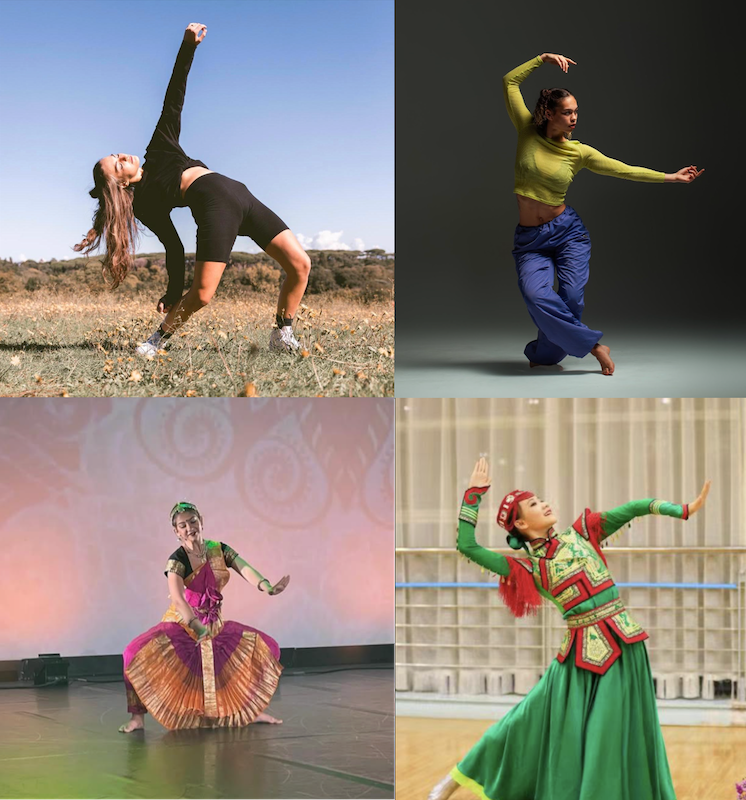
Featured in image: Micol Giovannini-top left; Rosa Lieckens-top right; Guilia Carastro bottom-left; Jingqui Ma bottom left.
By Sanjeevni Iyer
When Uday Shankar, the Father of Modern Indian dance, once said, “More than anything else, art has no boundaries of nationality, race or creed…,” he stated an idea that remains relevant even today. Drawing on movement patterns, body isolations, and nuanced expressions from Indian dance forms, young and emerging contemporary dancers are identifying alternative methods to enhance their performance and expand their creative possibilities.
Reflecting on their journeys, some of these young dancers, among whom are graduates from the Northern School of Contemporary Dance (NSCD), Liverpool Institute for Performing Arts (LIPA), and a Master’s student at the University of Leeds, share how their learning a new dance form and culture evolved into a deeper artistic connection. They reflect on discovering new ways to refine their craft by developing focus, learning about gestures and holding the gaze, storytelling through nuanced facial expressions, and ultimately deepening their passion for dance.
“Indian classical art forms bring depth and dynamic patterns to contemporary movements. Learning and incorporating these art forms changed the way I approached movement, making me realise that they are not separate styles but can blend seamlessly into a unified form of expression,” shares Micol Giovannini, a professional contemporary dancer and a recent graduate from LIPA, who was first exposed to kathak, under Dr. Mitul Sengupta and Dr. Shambik Ghose of Rhythmosaic Dance Company. Training in different Indian art forms, as Giovannini shares, also helped her build on her passion for exploring narrative and theatrical styles of expression. Devika Rao, the founder of the eponymous dance company, who introduced Giovannini to bharatantayam and yakshagana (folk dance theatre), for a production collaboration, recalls, “When I first met Micol and understood her interests, I introduced her to Yakshagana, as it is celebrated for its vibrant characters, dramatic narratives, and expressive performance style.”
Similarly, Rosa Lieckens from the NSCD recalls being fascinated by the forms taught by Devika Rao, “I was intrigued, especially by the way they told stories through defined postures and facial expressions, and how every gesture carried meaning.” Touring in Sonia Sabri’s Mughal Miniatures production in 2025, Lieckens adds, “It helped me pay more attention to detail, focus my gaze while performing, and most importantly, better isolate and connect with every part of my body.”
In the case of Giulia Carastro, these forms ignited a ‘fire’ within her. She found herself increasingly drawn to the expressive depth of these art forms, feeling compelled to explore abhinaya further. “Learning and performing Indian classical dance has always been a meditative experience,” she shares. Rao further adds that Carastro’s strength lies in balancing dynamic physical movements with nuanced facial expressions, allowing her to excel in demanding and emotionally complex performances. For Carastro, cultural familiarity with a story is not a prerequisite; rather, it is about her embodying the characters and genuinely connecting with the story as a human being, through careful research and internalisation of each role. She also identified unexpected parallels with classical ballet in their shared emphasis on discipline, mathematical precision of positions and postures, facial expressions, long-form repertoires and the ability to communicate emotional depth.
Reinforcing this intersection of disciplines is Jingqiu Ma, a contemporary dancer and a Master’s student at the University of Leeds, who recently collaborated with Balbir Singh Dance Company and Devaraj Thimmaiah, a London-based Kalaripayattu artist, on a work exploring the cultural significance of horses in Mongolia, combining Mongolian folk dance with traditional Indian Kalaripayattu movements. Recalling her initial encounter with Kalaripayattu, Ma shares, “Initially, when I started collaborating with Devaraj and Balbir, it wasn’t easy to adapt, but I knew that there was definitely something new for me to learn. Working together helped me develop new ideas, become more conscious of maintaining eye contact, and combine emotion with greater flow and flexibility in my movements.”
Drawing on his experience creating several productions featuring contemporary and Indian classical artists, Balbir Singh MBE, Artistic Director, mentor, and Founder of the Balbir Singh Dance Company, reflects on the value of such artistic exchanges. He explains, “I see both forms of dance as equal, with each fostering creativity and cultural exchange while offering valuable lessons to the other. Indian dance techniques, for instance, deepen contemporary dancers’ understanding of facial expression, storytelling, representation of characters, and a different approach to musicality, while contemporary techniques encourage Indian classical dancers to explore full-body movement, adaptability, improvisation, and diverse performance settings.”
Sharing a similar perspective, Ma adds, “In dance, there are no cultural or geographical limitations. In both India and China, classical art forms hold immense significance, and collaborating has only helped us celebrate and share those traditions more widely.”
Rao finally notes how this approach to interdisciplinary collaborations is a “revolutionary shift” in the performing arts, one that enables “us to explore more creative avenues and create better opportunities for these young dancers.” Ultimately, these collaborations demonstrate that for emerging dancers, cultural differences, borders, race or even a lack of prior exposure matter far less than a shared commitment to the art, in whatever form that may be.