
Srishti: Nina Rajarani Dance Creations
London Harrow Arts Centre, 26 April 2026
Review by Priyanka Basu
The 35th anniversary celebrations of Srishti at the Harrow Arts Centre was a two-part programme showcasing a mix of young and established dancers that the organisation has been honing for many years now. The first half of the anniversary performances featured children and young adults from the Srishti: Nina Rajarani Dance School presenting snippets from their ongoing training in Bharatanatyam. The second half in the evening presented Play Ball– a triple bill by Srishti: Nina Rajarani Dance Creations. Play Ball—comprising three choreographies in the Indian classical dance styles of bharatanatyam and kathak—is a touring performance, currently on tour in the UK (2026).
Play Ball features an ensemble of dancers and musicians onstage in three distinctly diverse pieces- Kadala: Is It Love?, Bend It and Quick!. Nina Rajarani MBE, artistic director, choreographer and dancer of the ensemble takes centre-stage in the first choreography, joined in by Y Yadavan, composer and vocalist (Carnatic style). The dancers in all the three pieces include Abirami Eswar (kathak), Kirsten Newell (bharatanatyam), Jahnavi Sheth (bharatanatyam), and Greeshama Thilakan (bharatanatyam). The musicians include Preeti Mahenthran (flautist), Kumar Raghunathan (violinist) and Abhiram Sahathevan (mridangam).
The triple bill starts with Kadala: Is It Love? in a soft pace depicting a woman’s dilemma about the fidelity of her lover. Nina Rajarani executes an array of lasting and fleeting emotions in the first part of this piece before she is joined by the four dancers of the ensemble. The dancers enter with repetitive movements underlining the protagonist’s state of mind before the choreography picks pace. One of the highlights of Kadala is its fast-paced movement patterns, which becomes a dialogue between the two Indian classical dance forms- bharatanatyam and kathak. Nina Rajarani excels in this sequence as she alternates between its nritta and abhinaya elements, while Abirami Eswar stands out as a striking kathak dancer, graceful and controlled in her movements and stillness (thehraav).
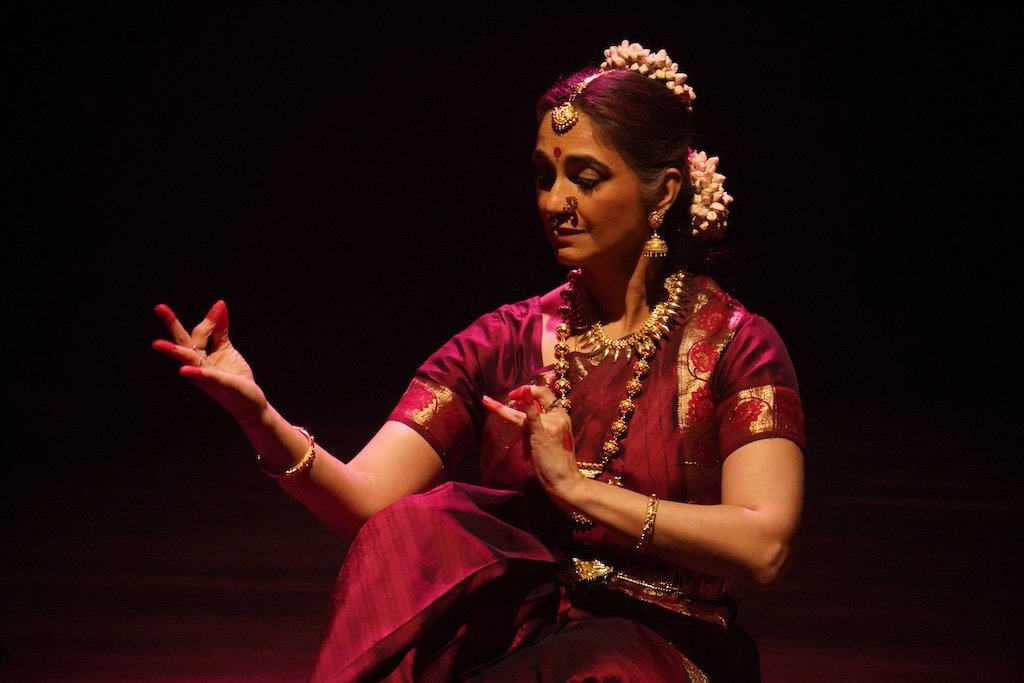
Image credit: RN Sudhi
Bend It, the second enactment is almost a dance-theatre piece bringing the dancers and musicians together in a football match. Seemingly incongruent—football and Bharatanatyam—Bend It truly is the essence of Play Ball as it shows the intricacies of ‘the beautiful game’ through complex bharatanatyam movements. The dancers chase an imaginary ball, role-play face-offs on the field (stage), perform replays and alternate between rapid footwork and lingering yet perfectly agile bends of the bodies. There are a range of emotions too, as the player-dancers move through the excitement of competition, the thrill of chase, the frustration of misses and the joy of victory. Bend It is held together by the skilful presentation of the four dancers of the ensemble with the music rising and flowing almost like the imaginary ball.
The final choreography, Quick!, has previously won the prestigious Place Prize (2006). It places the dancers and musicians together as employees in the cut-throat corporate world. The staccato movements are paired with daily rituals such as waking up, getting dressed, commuting to work and so on. Quick! is seemingly bereft of emotional exegesis like the preceding two acts, but it is centred on the vulnerability of individuals. From deadpan faces on a crowded public transport to the nuances of a rivalry-driven environment, Quick! successfully stretches the remits of Indian classical dance. It is almost as if the vulnerabilities within the classical Indian dance world spill into the make-believe world of the corporate that the dancers embody. Quick! is perhaps the only piece within the triple bill that achieves a convincing balance between the live performance and the visuals onscreen. While it remains representative of how Indian classical dance forms could speak to the ‘contemporary’, it would be interesting to see how this piece unfolds going further with the speedy digitalisation globally.
Play Ball genuinely captured the spirit, rigour and commitment of the performers within the ensemble in the celebratory spirit of its 35th anniversary. What stood out in the performances was the coming together of the dancers and the musicians without delineating separate spaces for them onstage, which is the usual practice. Indian performing arts has always been a dialogic space for the two, and Srishti brings this relationship out effectively in the triple bill.