
22 October 2026
Midlands Arts Centre, Birmingham
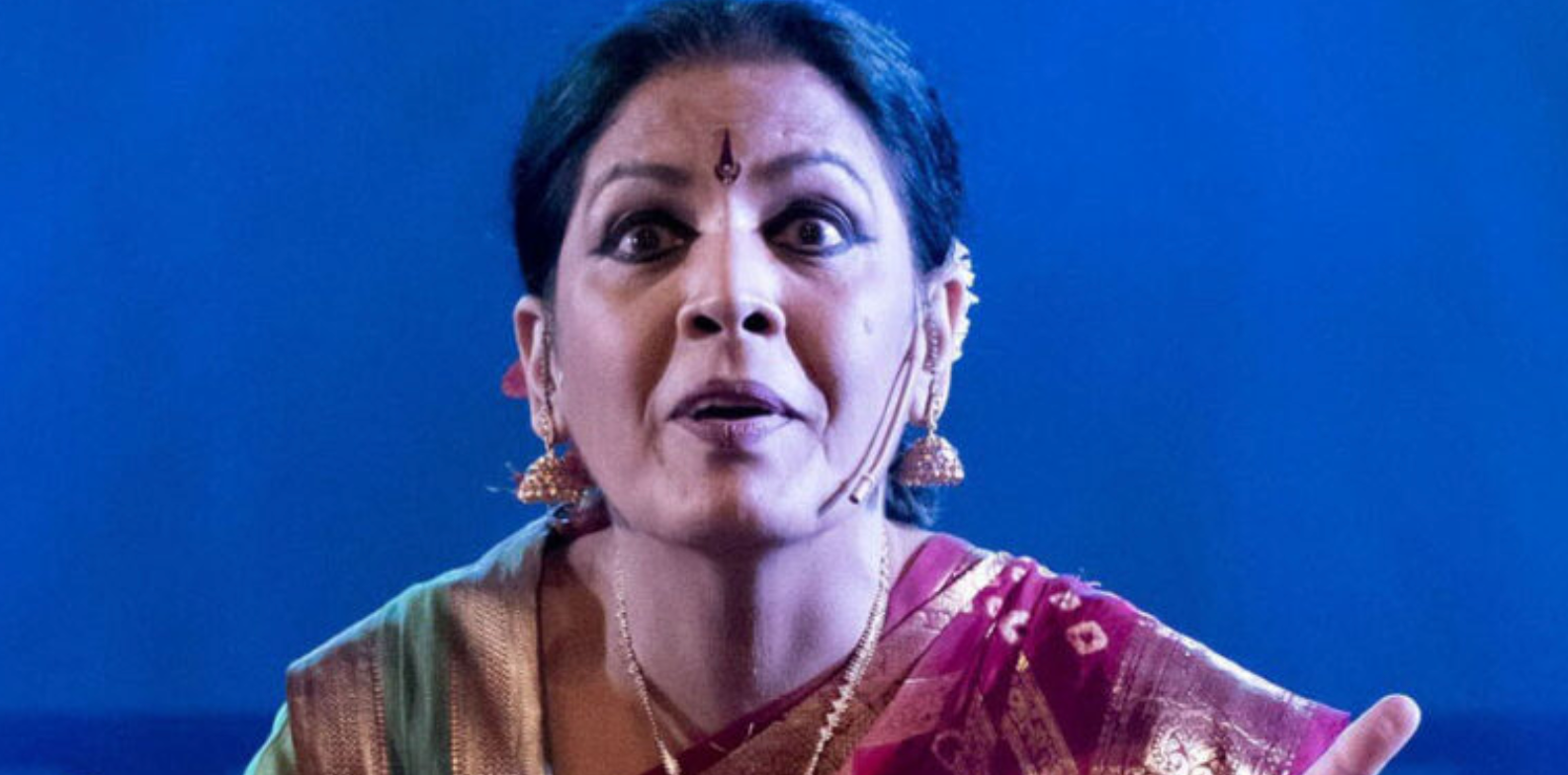
Performed by Ramaa Bharadvaj
Presented by Sampad
Write-up by Kali Chandrasegaram
Writing a review on a performance for me it is either going to be full of constructive criticism like questioning the subject in relation to the presentation, the relevance of it in this day and time, commenting on the staging, the choreography, lighting, costume, or being overly appreciative with an overuse of superlatives. For Avatarana, the latter was the review I had in mind, although the costume with the puffed shoulders is debatable, a personal preference, I guess. I decided not to go down the superlatives route and instead dig deep into the revelation, for me, of Natya – the very first performance ever, according to the bible of South Asian dance the Natyashastra. Created by Brahma the Lord of Creation but not quite, according to Bharadvaj, it was Vishnu the Lord of Preservation’s idea. So, Brahma and Vishnu had a meeting and came up with Natya which was then codified and compiled into the treatise Natyashastra, that all South Asian classical dancers follow “diligently”. Well, that’s not the point here, the point is what is the Natyashastra actually telling us through the first ever flawless performance that was presented by Bharata with his immaculate cast?
The performance was Samudra Manthana – Churning of the Milky Ocean, which was brilliantly executed by Ramaa Bharadvaj as a one woman show with excellent storytelling and comedy. There I go with my superlatives, I can’t help it, it was that good, no comments there. Bharadwaj got me as soon as she danced onto the stage in prayer to the four directions, paying respect to the space.
Dhanteras is the first day of Diwali and Diwali is celebrated over three days. I only just learnt about the three-day celebrations. Being a Malaysian, we only celebrate Diwali on the one day. This information is thanks to Mansi Dabral’s Diwali storytelling at a performance in St Thomas’ hospital in London (all relevant information in this consolidation of a thought-provoking reflection). The story behind Dhanteras (every Hindu festival has a story attached) is the Churning of the Milky Ocean, Samudra Marthana… the same first ever performance by Bharata in the Natyashastra and the penny drops! Dhanteras is in prayer to the Lord of Health = Dhanvantari. The significance of Dhanteras (according to Wikipedia) is the celebration of health, my favourite topic. Thank you, Dabral, for instigating this realisation that led me to join the dots and get excited about the Natya. I am definitely celebrating the first day of Diwali from now on. The ethos of good over evil as the popular Diwali message with stories of Narakaasura (the demon) defeated by Krishna ((the god) on the second day of Diwali and the Ramayana where Ravana (the demon) is defeated by Rama (the god) on the third day of Diwali doesn’t float my boat. Maybe it’s because I always played Narakaasura and Ravana. The character researches revealed that deep down these villains were actually good , but due to circumstances and triggered by uncontrollable emotions, their inner demons are released. Thus is life.
There’s a wealth of knowledge to be gained in the story of the Churning of the Milky Ocean, that which explains the origin of the elixir of life. The story goes that when the demons and the gods took either side of the churn holding the king of snakes – Vasuki as the rope and the Mount Mandara as the rod of the churn and Vishnu’s avatar Kurma – the tortoise as the base, the nasty poison came out first which was taken by Lord Shiva and then followed various gems the last of which was Dhanvantari which literally translates to ‘moving in a curve’.
Samudra Manthan teaches that the ocean of life must be churned — through effort, discipline, and suffering — to bring forth treasures. Poison (suffering) comes first, always. Only those who can endure the poison (like Shiva) and maintain their dharma will eventually receive the nectar. The story is a complete metaphor for spiritual practice (Sadhana). bakathisagar.in
To me the gods and demons are representations of our own inner critics, the devil on one shoulder and the angel on the other. In Avatarana, Bharadwaj called it her doppelganger, who contradicted her a couple of times in her own one woman show which was treated as a comical interception, a clever touch indeed. We all have our inner voices that most of the time are in contradiction and how do we manage them is the point of healing. In the hiatus of the war between the good and evil within us is where the actual healing happens, when the mind is calm, creating a space to think and have a rationale hence paying respect to the space by Bharadwaj is significant.
The gods and demons on our shoulders are constantly at each other and I am the churn in the middle caught in contradiction in the mind and the only way is to go inward, dropping into the hiatus of the body to discover the gems. The body is a gem that we take for granted.
I write this on the auspicious first day of Diwali, Dhanteras with the wish of a healthy understanding of the body is a powerhouse and the most precious of gems. The act of sanctifying the space by Bharadwaj at the very beginning, the similar practice observed on Diwali morning, indirectly paying respect to the space within and the thorough dedication to the different key elements in the Natyashastra emphasizing the storytelling with voice, movement, rhythm and expression as sadhana – a spiritual practice of an individual, Avatarana is a homage to the self. Bharadwaj hits the perfect pitch in the body’s attunement.