
Payal Ramchandani
Dance City, Newcastle,
22nd Nov 2025
Reviewed by Sudipta Roy
Image credit:Luke Waddington
The title gives one some inkling of the context of this dance-theatre performance by Payal Ramchandani with excellent live accompaniments provided by Prathap Ramachandra on percussion, Vijay Venkat on flute and Ramya Tangirala, vocals. Rehearsal Director Debbie Fionn Barr and Technical Manager Matthew Carnazza also deserve a mention here, because the sets, lighting, and arrangement together contributed to the creation of an emotive and unique performance.
Payal is a north of England-based performer, with a rigorous education in the South Indian classical dance style of kuchipudi. Her recent works include a variety of productions: The Forest Dream, created to highlight the urgency of the climate crisis; Once In a Blue Moon; Of Love and Lament. The collaboration with different artistic disciplines and forms to enhance the emotion and accessibility of the overall concept is at the core of her work.
Kuchipudi is well known in India (it is thought to have originated in Andhra Pradesh). While it is less well known in the UK, it is one of several other dance forms which are slowly gaining recognition in the West. As with other classical dances, there is a system of story-telling which is used in the performance. However, in Just Enough Madness, the dance form is one element in the overall story-telling. Payal’s performance was excellent and her powers of abhinaya were outstanding; but it is the live accompanists who enhanced the dance to a level where one could feel the pain and the joy projected to the audience. That this was done whilst maintaining the rigour and precision of the different art forms made it truly enjoyable.
Audiences of Indian classical dance forms are familiar with the expression of the feelings of youthful love (shringar rasa of Radha-Krishna) and the joy of motherhood (karuna rasa Yashomati-Krishna). This performance explored the almost unspoken, and I would say, yet uncategorised feelings of loss of identity (as a woman) whilst embracing motherhood, the extreme grief of miscarriage or loss of a child, or mental health issues arising from such experiences. This was a very bold and lateral move from the path more trodden. There are some examples of such extreme grief through poetry – and therefore the choice of live poetry, incantations, vocals and percussion enhanced the mood.
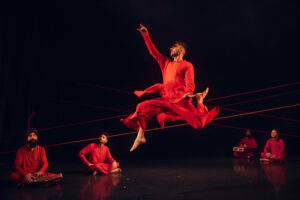
The performance started with Payal and accompanying artists slowly developing the concept of the flowing and ebbing of joy and emotions, which slowly ventures into the mental issues. The use of change in rasa, dance and percussion along with the vocals and flute to move in and out of these moods, emphasised the agony and ecstasy. Coloured ropes entangled over and over depicted the slow journey into different mental states, with excellent use of space and lighting integral to the effect.
I was especially intrigued by the section where the dancer sways between the joys of childhood, which are lost (forever) as motherhood beckons. But for some, even that doesn’t happen. This was conveyed through the choice of Devaki (Krishna’s birth mother) as protagonist. She was imprisoned by her brother and gave birth to seven children (Krishna being the eighth child) who were all killed (or destroyed) by her own brother. She witnessed the destruction of her children again and again, and this trauma remains mostly unspoken and unacknowledged. Indeed, there are few songs or dances which invoke her fate, her trauma and loss; and she is largely forgotten in the mist of myths. Indeed, I found the focus on the ‘silenced’ feelings and the invocation of a less-remembered character from Indian mythology truly unique in this performance.
There was a post-theatre discussion, which gave many of us the opportunity to hear from the artists themselves. This was very useful: we were helped to understand the challenges faced in conceiving the performance and how it has changed almost beyond recognition over the four years since inception. It was also illuminating to learn how the staging had to be assembled and arranged to bring the concept to the audience. As a student of music myself, I found the use of music in the performance powerful.
Sudipta Roy is a student of Hindustani vocal music and a Chemical Engineer.