
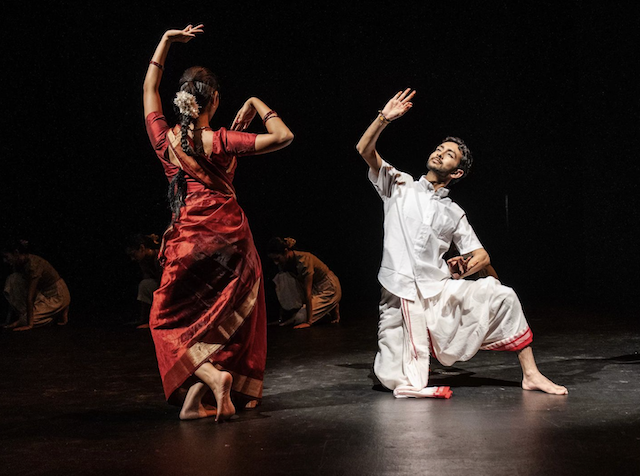
Leonard Davis Center for the Performing Arts
13, 14 November 2025
Reviewed By: Jeeno Joseph for Line & Verse
Photography credit: Dora Nano
Dancers: Shalini Basu, Keshav Agiwal, Samanvita Kasthuri, Rutva Satish
Jeevika Bhat’s Clothesline (ಒಂದು ಸೀರೆಯ ಕಥೆ) unfolds as an imaginative, tender, and surprisingly humorous meditation on culture, inheritance, and the many forms “home” can take. Rooted in South Asian and specifically Karnataka identity, the production manages to feel universally resonant, speaking not only to those who have draped a saree, but to anyone who has carried memories, language, and tradition across time and geography.
What makes Clothesline immediately striking is its conceptual anchor: the story is told through the eyes and folds of an anthropomorphized saree. This single garment becomes witness, companion, and metaphor as it travels across three generations: grandmother, daughter, and eventually a granddaughter navigating life in a foreign land. From the bustle of the saree market to the quiet intimacy of a family closet, from ritual draping over a pregnant belly to the chaotic tumble of a washing machine cycle, the saree becomes the thread that binds experiences across time.
Bhat’s movement vocabulary is wonderfully eclectic, seamlessly weaving together contemporary movement with gestures drawn from odissi and bharatanatyam. What could have felt disjointed instead becomes a textured language, one that mirrors the hybrid identities of many first and second generation immigrants. The cast, composed of dancers with visibly diverse training backgrounds and experience levels, never detracts from the storytelling; in fact, their variety feels intentional, even welcomed, underscoring the idea that cultural inheritance is not uniform. It is lived differently by each body that carries it.
The first half leans more heavily into nritta, offering clean lines, rhythmic clarity, and glimpses of technique across the ensemble. While the diversity in movement backgrounds is beautiful and appreciated, future iterations of the work would benefit from the dancers leaning even further into and absorbing Bhat’s movement style. A deeper embodiment of her choreographic language could create a more cohesive flow while still allowing each performer’s individuality to shine through. Doing so might draw the audience further in during the first act and strengthen the production’s initial pull.
The opening act, framed as a kind of dance-based foreshadowing, evokes sorrow and unease, a striking emotional tone that is not immediately contextualized for the audience. While beautifully performed, its place within the larger narrative becomes clear only later, during the post-show Q and A, when we learn that this section is meant to hint at themes that emerge further into the work. With that knowledge, the opener gains resonance in hindsight. Future iterations might simply benefit from offering the audience a touch more grounding so the emotional intent of this first piece can land even more effectively.
Some of the most evocative sequences are those that merge humor with heart: the playful portrayal of a saree being washed, tumbling and bleeding onto other garments, becomes both literal and symbolic, the washing away of old layers, the unintentional transfer of history, color, and memory. Later, when the saree reaches the youngest generation, it finds new purpose and meaning, suggesting that culture may shift shape, be reinterpreted, or evolve in unexpected ways, yet still be cherished and carried forward.
This was very much a slow burn, one that drew the audience in closer and closer as the production progressed. What began with curiosity deepened into connection, and by the end, the work radiated a sense of comfort and tenderness. One audience member post-show described the experience as “a warm hug,” and I had to agree; the work surrounds you gently before you fully realize how invested you have become.
Ultimately, Clothesline is a deeply relatable work for immigrants and children of immigrants who grapple with what it means to preserve, reinterpret, or even gently let go of aspects of their heritage. It is heartfelt without sentimentality, creative without pretense, and above all, sincere. Jeevika Bhat crafts a story that feels as personal as it is collective, reminding us that culture, like cloth, softens, reshapes, and survives, always finding its way home.



Jeeno Joseph, What a review!
Did you watch the show only once or several times? You grasped the finer aspects of what Jeevika expressed, without any gaps or adulteration. Your written expression is as wholesome and warm, as the show itself. Your feedback and suggestion flows gently and yet conveys the message, in a sincere manner. I hope you continue to review her future works too.