The Place Theatre, London
28 February 2026
Reviewed by Vipul Bhatti
Image credit: Camilla Greenwell
The precision and detail that Chandenie Gobardhan choreographed in her first full length work Caught Again in the Net of Rebirth is spellbinding, unravelling a metaphysical story of the birth of the universe and the arrival of the human race. It is sweeping in its scope, referencing the stages of evolution from a harmonious beginning to struggles for domination before equilibrium is re-established.
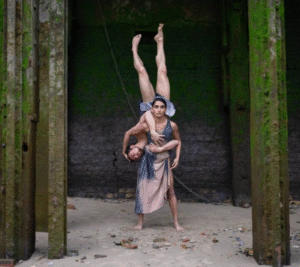
Caught Again starts in absolute darkness, forcing a sensory shut-down, except thunderously heavy and long notes resound. There is no melody, the musicality of outer space does not chant AUM, but the vibrations are felt, their ethereal force gives birth. A quintet of bodies emerge as a close unit, crossed-legged, their faces masked by hands and wide-spread stiff fingers. They manoeuvre on an unstructured axis, back and forth, around and anticlockwise, elevating and descending, looping in a hypnotically engaging mechanical configuration. In their fixed seated positions, the quintet’s movement accelerates in a circular pattern in various directions. The intensity of this sequence is captivating. By covering their faces, individuality is erased to emphasise the universal. Their arched spines move from robotic coordination to fluidity with detailed articulation.
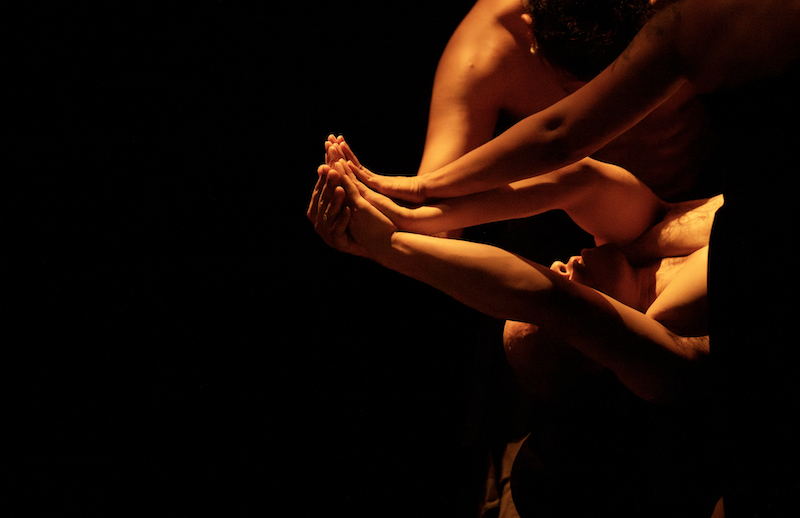
From their unison, dancers Elsa Roy Gupta, Flo Kabasubabo, James Olivo, Ser Sebico, and Gobardhan herself individually pop, correcting their limbs to organise into a functional momentum to crawl. These primal steps become the first footprints of early non-human life – their raw physical range is pushed in the first-third of this narrative and continues to surprise. A moment that generates gasps from the audience is when touch is seen, deepening the contact connection between the five dancers through intertwining and holding, weaving and clasping, releasing and eventually surrendering as their hands and fingers pulsate like exhausted tentacles. In what originally appears as simple movement, traversing across different planes and intersections, reveals a complexity which would impress Da Vinci’s own principles of humanism, geometry, anatomy and art, as applied to his ‘Vitruvian Man’ drawing.
The quintet continue to realise mighty ideas, particularly the re-enactment of the big bang theory. In their version a trio crawl to construct a portal from which Gobardhan is born; a personal interpretation of this is that the universal soul is of SHE energy as opposed to HE being the almighty creator. The gender issue invites further reflection but at this point the theological, scientific and political theories and perspectives are deliciously latticed together. Upon witnessing the birth, the end of life’s cycle is seen in a tableau depicting the passion of Christ. A mother cradles her child’s death as its soul transcends to another purpose signalled by a conch shell’s cry, a signature sound which ancient Indian and mythological accounts have foretold as the official declaration of war.
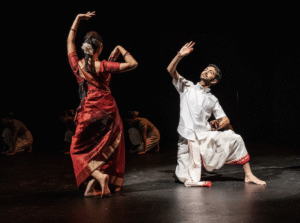
The dark space is transformed into a battlefield, the dancers’ iron-like arms attempt to spear through one another, warriors fighting for freedom, for authority, strategically executing with stoic dedication. When their hands drop from their faces, they are revealed as celestial beings. Some versions on universe’s creation state that gods and goddesses were its original architects. Gobardhan’s dance background is from a childhood rooted in bharatanatyam to a BA and MA in dance at Fontys Academy of Art, forging a style that combines Indian classical with contemporary and street which is evident in her approach crafting movement ideas from her dance sensibilities and building them with universal concepts of war, chaos, survival, belonging and equal rights.
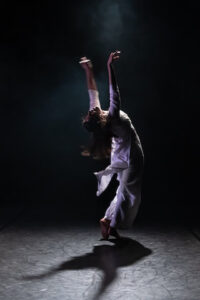
Each of the dancers are strongly individual, from the magnitude of their physicality to their soulful presence. As a collective they nimbly shift from softness to wild forces as the five of them swirl, rotate, spin, orbiting into a frenzy before retiring to a calm stillness, displaying their backs to reveal the chaos within.
The score by Torben Sylvest, in collaboration with Raj Mohan, Avi Kishna, and Krithika Soma, also has colossal impact, its abstract composition is threaded by virtuosic melodies which amplify the dance themes. Gobardhan presents a great story on our humanity and with humility, it is a telescopic sighting into creation, an astronomical tale of existence. Regardless of where or how we are birthed to who we become, Caught Again in the Net of Rebirth is a powerful statement that, more now than ever, the human race has a face that we should recognise as our own.