
Jaivant Patel Company
The Place, 3 March 2026
Review by Pranav Yajnik
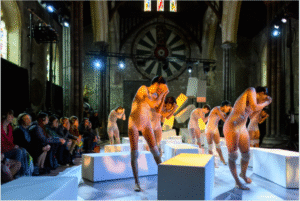
With the lights up and the stage marked out in a square of blue light, the dancers walked through the space, ships in the night: sometimes edging to an encounter, sometimes a-cruise at a distance, but always passing. Two dichotomies: the “British” and the “Asian” from British Asian; and the “LGBTQIA+” and “not”, and specifically “Not, because we’re Asian.” Thus the costumes flipped from the conservative and plain to the gay and gaudy, while fragments of popular music played in the air, Freddie Mercury and Alka Yagnik alike. A glance, an approach, a frustrated movement, and they walk on.
“Will the audience talk through the whole thing?” asked the man next to me.
Luckily for him, it wasn’t long before the house lights fell and Astitva in its four parts of Seeking, Desire, Acceptance and Love began. The piece trajected the dancers from strangers, via sex and affinity, to lovers. Beneath the warmth of the club lights, the heat of the dancer’s gazes raked over every potential target. And yet not for long: with the familiar disposability of casual sexual encounters that defines the lives of many a gay man, every touch was tentative, every embrace, in the end, temporary. As a portrayal of gay culture that relies on hook-ups for connection, so far, so very accurately-observed.
Well-observed too were the vox pops of the three dancers between the dancing: attitudes that many an LGBTQIA+ British Asian had thrown, statements they had to make, peace they had to find. It was in its observation that the choreography found its strengths, identifying and directing with ease moments that a viewer recognised, related to, or had lived through. The adage when writing, in order for it to work, is to “write about what you know,” and the success of those moments relied on the choreographer delving into his own experience of growing up in the atmosphere of a certain period to birth the many vignettes of this piece. Another strength was in the relationship between the three dancers, Amar Bains, Dom Coffey and Mithun Gill, all with different energy, but all who had clearly invested time realising and making fluid the necessary intimacy on stage.
During the first half of the show, the choreography was mostly straightforward in its dynamics, although evolving into some moments that were pleasingly knotty and which the dancers executed with fluency. It was in the second half of Astitva that the audience, who had been teased with glimpses of the dancers’ considerable abilities, began palpably to yearn to see them spread their wings and soar out of the subdued choreography. An obvious section for this was the third part, which could easily have translated its theme of ‘freedom in acceptance’ into an extended section of technical choreography in whatever chosen style, which would have been powerful by its contrast with the surrounding material; and for a while, it did seem that the choreographic energy was increasing and the audience would be given what it hungered for – but then it subsided into the previous simmer.
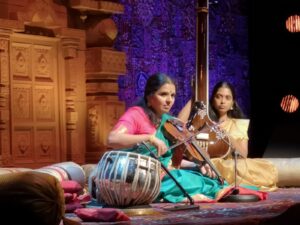
The score, although not without modern touches, was distinctly classical, Alap Desai bringing a depth and emotion with a sustained and coherent piece of music. The choreography sat squarely upon it, but they were not tied together in the way of responding obviously to each other; rather more akin to a film soundtrack. Lighting effectively supported the action: the restrictive framework of the blue square reflecting the main concerns of the piece; unusually warm tones echoing the love and desire and not a little tension.
In a world in which certain voices shout loudest, we need concepts like that which Jaivant Patel and the dancers have created. With some easy adjustments it could really fly, for it is ultimately a warm, humane and celebratory show which materialises the indistinct, hazy foundations on which some of us are built but which are rarely openly acknowledged – if only to confirm to us that other stories can exist; there are a legion narratives outside the mainstream; and in love, everything can be solved.