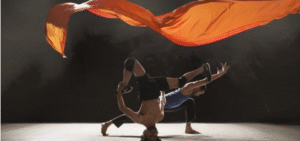
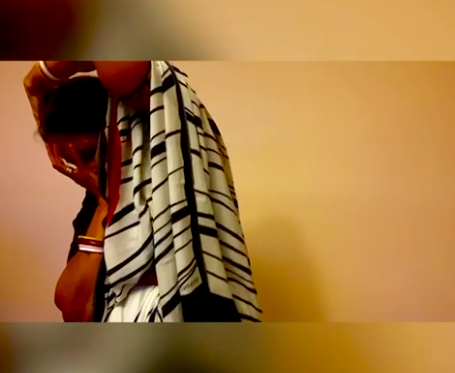
The state of being in Fear, Bhayanaka, followed Veera or ‘Courage’.
The first part was a lecture on rhythm and the second part was the practical session on understanding fear through the movements generated from the experience of fear; or rather, a movement motif evolved from a personal take on the idea of fear.
The session introducing rhythm was led by Hiren Chate, a highly skilled tabla player with a deep understanding of music and love of dance. He enjoys working with dancers and is so curious about the rapport between dance and music that sometimes he tries dance steps himself to understand the mechanism of how dancers move to certain passages of music. However, the subject that he was trying to explain was too sophisticated to teach in an hour-long dance workshop, especially for participants who were not familiar with the Indian counting system. The title of the course ‘Road to Nine’ inspired him to think about a Sankirna jati (9 beat) rhythmic composition. What the course participants needed was something simpler. It would have been more beneficial to see how rhythm can connect to different moods or states of beings.
Kesha Rai picked up the session from where she had left it in the previous session. In her mind she sees fear and courage as two complementary emotions. Once again she started the session by screen-sharing a series of pictures: first, a colourful image of the head of a lioness; then a deconstructed face of a woman; a few images of booth dancers; lastly, Picasso’s anti-war painting Guernica. She connected the images with some interesting thoughts and observations such as ‘negative feelings are never linear’: as soon as one gives way to fear all sorts of chaotic thoughts rush in. The picture with which she connected this observation had various curvilinear figures. This practice of taking inspiration from visual images brought back the memory of the time when Sanjeevini (Dutta) and I had an opportunity to work in the Walker art Gallery in Liverpool.

We looked at the paintings and realised the power of lines, how a slight change in a line can express different feelings. We found the right movements and the expressions for our production ‘Tending the Fire’, a creation story told through the dialogue between a grandmother and her dog.
The dance routine Kesha took us through had a touch of tenderness. To me it seemed less like being gripped by fear and more like a determination to overcome it. She was working on the principle of ‘from form to formless, fear to fearless’. ‘The body’, she said, ‘is a bag of memory’. She invited us to connect the body with the mood and become an archaeologist of our own body. In the routine Kesha had used a couple of mudras (specified hand gestures of Indian dance) mainly as a natural extension of her movement rather than making any reference to its traditional significance. In Indian dance training we learn about Rasa or the states of being with an emphasis on facial expression. Kesha did use face in her dance section but in a totally different way by pulling and pushing the face with hands to give a distorted look to express the inner emotion.