92NY, New York City,
21 February 2026
Written by Neha Kher for Line & Verse
The What Flows Between Us festival, curated by kathak artist Rachna Nivas, was a full-day immersion into Indian classical music and dance in conversation with jazz, opera, poetry, and tap.
I had the privilege of experiencing the festival not just as a kathak student or as an audience member, but as a production assistant. I got to be a small part of the planning and coordination for the weeks leading up to the show. Assisting 92NY’s production manager, Louise Brownsberger, was such a great learning experience to see how seamlessly the show was organized despite this being a completely new experience for her and the crew. They made an earnest effort in educating themselves on the artists, the ancient instruments and complex nuances of Indian classical music and dance.
At tech rehearsals, I witnessed the tuning of veena, the murmur of jazz chords, and backstage excitement. I saw dressing room laughter and last-minute recalibrations. To stand in proximity to artists whose craft has been cultivated over decades, lifetimes even, was humbling.
The day began with a marketplace fair curated by Ramya Shenoy and Deboleena Maitra, and featured South Asian artisans whose work felt intentional. Handwoven textiles, thoughtfully poured candles, poetry books, contemporary clothing rooted in tradition; the space felt less like a marketplace and more like a living archive of community.
The morning concert opened with Saili Oak singing ‘Rasiya Mhara’ (raag Ahir Bhairav), exploring a single melodic line through subtle, meditative variation along with Satyaprakash Mishra on tabla. You could feel the audience settling.
The program unfolded with Saili on Hindustani classical vocals with a Western string quartet. Devotional compositions warmed into rhythmic play. By the time the piece ‘Kachu Lena Na Dena’ arrived, the crowd was visibly moving – heads bobbing, bodies swaying.
When Nirmala Rajasekar, one of the world’s leading Carnatic Saraswati veena players, took the stage with her veena, an instrument that predates the sitar by millennia, the air shifted. Nirmala ji performed with two percussionists, Shubha Chandramouli on mridangam and Samyuktha Sreeram with the ghatam. The Carnatic raag Purvi Kalyani stirred something deeply emotional. The veena’s timbre felt ancient, electric, almost elemental.
And then, in one of the morning’s most unexpected moments, Nirmala ji’s daughter Shruti Rajasekar, a composer and vocalist herself, broke into opera-style singing during a Western composition. The audience audibly gasped.
This afternoon event began with Yamini Kalluri’s kuchipudi performance – fluid, expressive, sensual in its storytelling. A fusion piece with piano introduced abstraction, showing how classical vocabulary can stretch without breaking.
Later, poetry entered the room. Nandana Dev Sen recited her mother Nabaneeta Dev Sen’s Bengali verses, translating them to English as Neeharika Tummala interpreted the words through graceful abhinaya, accompanied by the soft resonance of sarangi by Rohan Mishra.
The afternoon event concluded with a much-awaited all-women percussion jugalbandi that felt radical. Tabla, mridangam, and ghatam – instruments historically framed within male-dominated spaces were in the hands of Ramona Sylvan, Shubha Chandramouli and Samyuktha Sreeram. Before they began, Ramona offered beautiful context by educating the audience about the tabla’s 250-year lineage from the pakhawaj, the mridangam’s mythic connection to Lord Nandi and the clay-bodied ghatam’s 1,500-year history.
One by one, they interpreted the same rhythmic phrase. The energy was electrifying yet generous. Where male jugalbandis often perform dominance and competition, this exchange felt collaborative and playful.
The afternoon session was a reminder that women have always been present in rhythm traditions. Sometimes history simply forgets to say so.
As the evening rolled around, the excitement could be felt in the air for the main highlight of the all-day festival: SPEAK. The stage was split: Hindustani musicians stage right, jazz ensemble stage left. A shimmer of ghungroos teased the space as sitar threads began weaving through jazz harmonies, making the most uniquely crafted tunes.The auspicious invocation ‘Ya Devi Sarva Bhuteshu’ sung by Ambarish Das rang out, powerful and grounded.
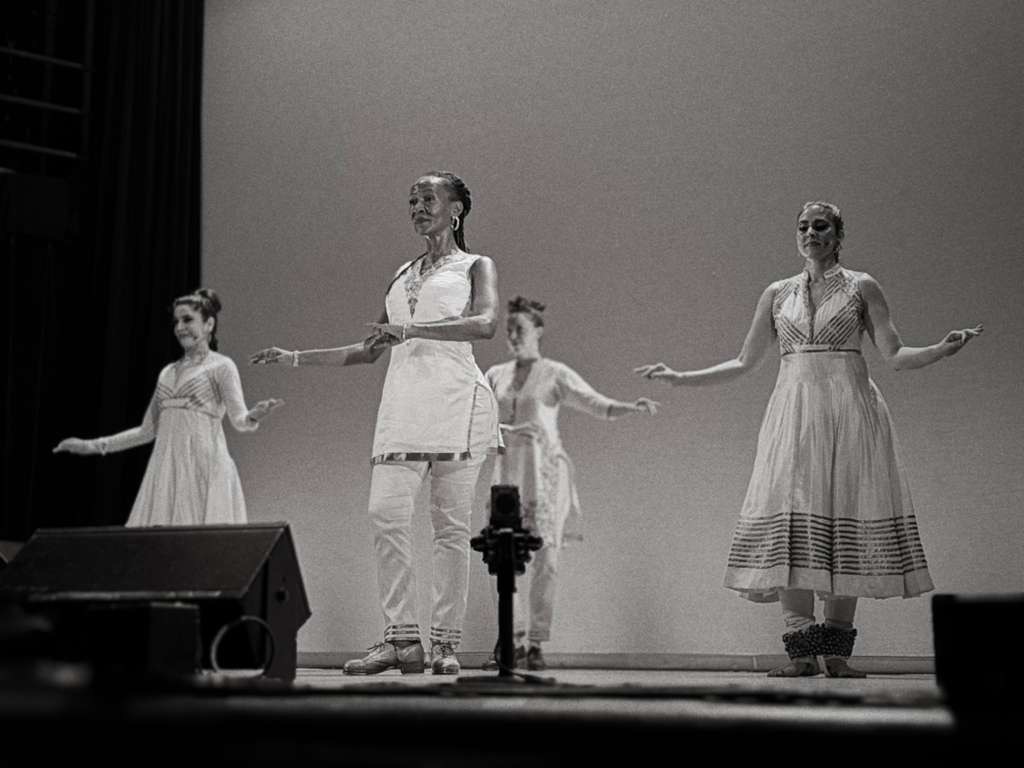
Rukhmani Mehta and Michelle Dorrance entered in a collaborative force – Kathak and tap in conversation. Precision met groove. Spins met slides. It was technically masterful and emotionally stirring.
When Rachna Nivas performed her solo, she was playful, luminous, fully at ease – improvising with Satyaprakash Mishra on tabla, tossing flying kisses toward the audience, reciting Kathak bols with clarity and joy. Watching my Kathak teacher command a stage like that is a particular kind of pride.
And then Dormeshia entered. The roar from the New York audience said everything. Her movement felt effortless and precise. A consummate artist.
What followed felt almost unreal: Kathak on jazz; tap with tabla; piano conversing with tihai. Sitar by Jayanta Banerjee threading through drum kit rhythms. What many people wouldn’t know is that while Jayanta da comes across as an introvertish sitar player, he is in fact the music composer of SPEAK and has carefully crafted every musical piece that flowed through the halls of 92NY that evening.
The finale gathered all artists on stage. One piece unfolded without music – rhythm generated solely by bodies. Then came a scat battle – Dormeshia vocalizing jazz syllables while Rachna answered with Kathak bols, transforming percussive language into improvisational fire. The audience was on the edge of their seats, jumping with delight.
By the end of the night, it was clear that the festival’s title was not rhetorical. What flowed between them and all of us was rhythm. It flowed between classical and contemporary; between Kathak and tap; between jazz and raag; between artist and audience. And perhaps most importantly, it flowed between women, across generations, geographies, and genres, asserting presence in spaces that have not always made room for them.
To witness this at 92NY, as part of their Women Move The World series, felt significant. To help, even in a small way behind the scenes, felt like standing at the edge of something larger than a single festival.