By Dhruva Lakshminarayanan
Photos: Vijay Krishna Indra Parameswaran
On the 31st of January, a frigid Saturday in the heart of New York City, people gathered into the cosy confines of a yoga studio with their freshly brewed chai and nostalgic desi snacks to witness ‘a Manhattan Margazhi Mela’, an attempt by Jeevika Bhat and Vaibu Mohan to teleport us all straight to the vibrant lanes of Mylapore, Chennai: A true Mecca for connoisseurs of the South Indian classical arts.
The evening opened with a bharatanatyam presentation of Bhogindra Shayanam, in raga Punnagavarali and performed by Pavitra Kumar. The piece, choreographed by Dr Priyadarshini Govind, evokes the poised undulation of Adishesha, the seven hooded serpent, whose ceaseless vigilance cradles Padmanabhaswamy in repose.
Pavitra demonstrated sharp, well-articulated footwork and technical clarity, effortlessly shifting between the swarams (notational parts of the song that call for rhythmic footwork) and the sahityams (lyrical parts of the song that require to be emoted). During some of these transitions, the pacing felt slightly hurried, leading to brief lapses in rhythmic precision. Pavitra’s commendable Sthayi Bhava of the snake: fearsome, yet stoic, watchful, and utterly reverential of the Lord, constantly reinforced the choreographic intent, however in a piece that was nearly 10 minutes long, the largely uniform abhinaya allowed for limited dynamic contrast.
The next performance of the evening featured Sunayana Jampanaboyana, who presented Brindavana Nilaye, a traditional kuchipudi piece dedicated to Radha’s undying love for Krishna. The composition unfolded at an unhurried pace, allowing the narrative to breathe. The use of lip-syncing, a hallmark of traditional Kuchipudi, was particularly effective, evoking the form’s strong storytelling lineage and clearly distinguishing it from the bharatanatyam presented previously.
The absence of salangai was noticeable, as their inclusion might have added a subtle rhythmic anchor to sustain momentum in such a slow-tempo work. While the measured pacing was refreshing, it also offered greater scope for expansive abhinaya and spatial exploration. At times, the energy felt subdued, and within the constraints of the performance space, the choreography appeared restrained. In a larger, less confined setting, the piece may have benefited from a fuller use of animated movements and spatial dynamics.
For the next piece, the audience was treated to a Carnatic music presentation featuring Vijay Krishna Indra Parameswaran on vocals, Tanisha Srivatsa on violin, Dhruv Hari on mridangam, and Sabareesh Viswanathan on Kanjira. The ensemble performed Pakkala Nilapadi in Raga Karaharapriya, a composition that beautifully depicts the happiness on Lord Rama’s beautiful face, as he is regaled by the gorgeous Sita and the stoic Lakshmana on his either side. The performance offered a vivid exploration of the vocal and instrumental possibilities of Raga Karaharapriya, seamlessly navigating high and low registers with intricate gamakas and aalapanais.
Vijay Krishna’s vocals were deeply emotive, especially in the Charanam, where the heartfelt sentiment of Saint Thyagaraja imploring Sita to tell him how she appeases the Lord so he may follow suit, shone through. Some of the experimental deliveries however, while intriguing, could have resonated more powerfully with a subtler approach. Tanisha’s violin beautifully mirrored and enhanced every subtle nuance of the raga, and the percussion duo, Dhruv Hari on mridangam and Sabharish on kanjira, provided seamless rhythmic support, infusing the rendition with depth and vitality. While errors in pronunciation presented themselves through the rendition, they were easily overshadowed by the passion and sincerity that resonated in every phrase.
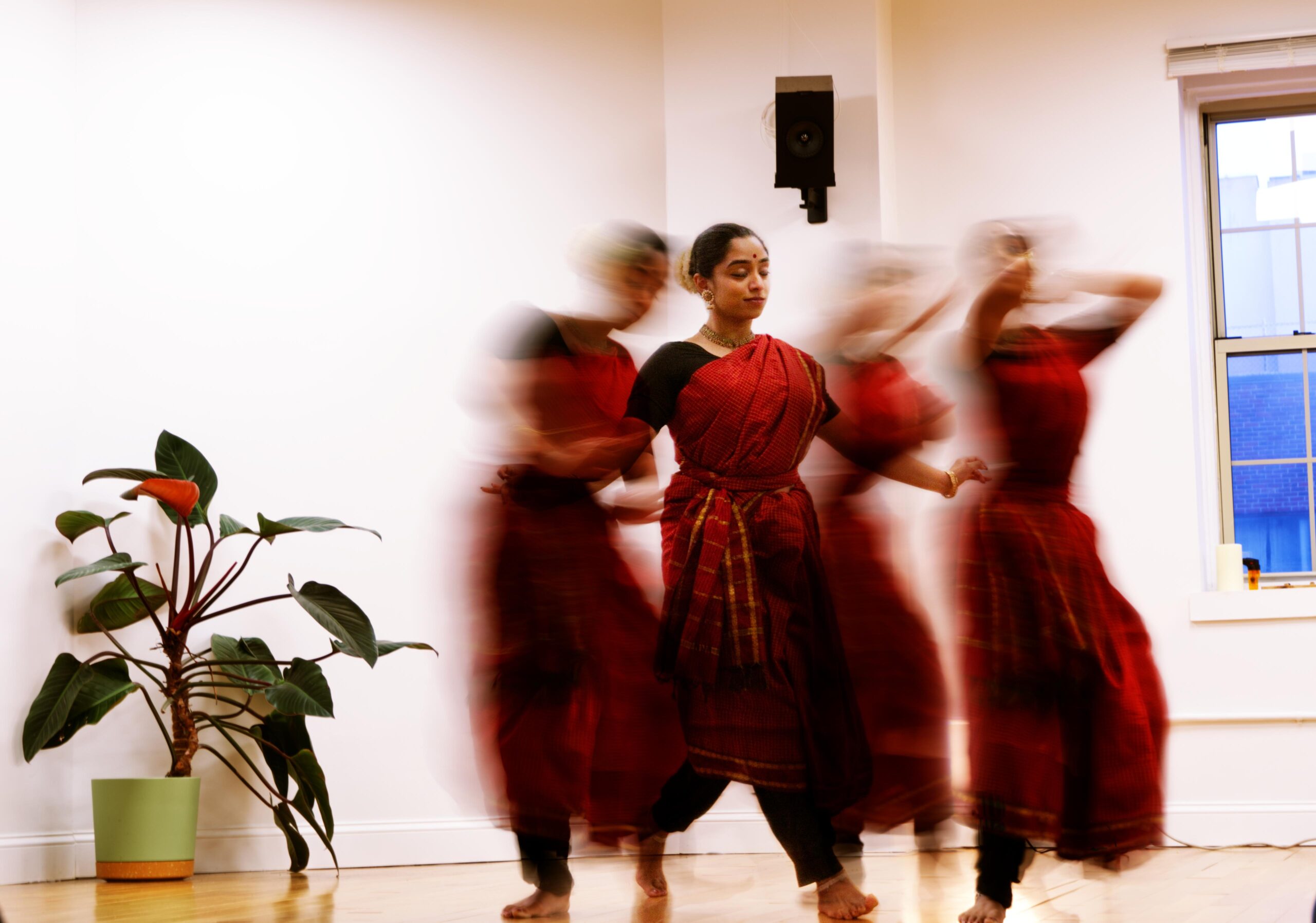
The next piece of the evening was “Nee Uraippai Hanumane” in Ragamalika penned by Arunachala Kavi, choreographed by Dr Rukmini Devi Arundale in the typical Kalakshetra style, emphasizing precision, geometric patterns, and highly structured, meticulously rehearsed abhinaya, and executed by Nethra Gururaj.
The lyrics of the song depict Rama instructing Hanuman to meet Sita in Lanka and remind her of him through various instances from their lives, blending storytelling, and musicality. The ragamalika song was especially engaging because of an very creative touch: the name of each raga was woven seamlessly into the lyrics of the composed charanam. For instance, in the Dhanyasi ragam, the charanam goes:
“Muni Orutthan Yaasika Pin Shendru Thaatakayai
Panai Pol Vizha ADiththen Pagaruvaai Eee Sollai”
Nethra’s footwork was extremely sharp, with every expression, abhinaya, and step thoughtfully executed. While the precision and discipline were impressive, at times it might have been interesting to let the emotions flow more freely, allowing the narrative and sentiment to envelop the viewer.
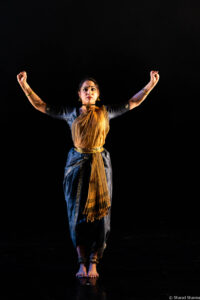
The next piece of the evening was a mohiniyattam performance by Kavya Menon, who began by noting that a mohiniyattam dancer should move like a stalk swaying in the wind, a vision she brought to life with effortless grace. The composition, Ha Hanta Santapam by Swati Tirunal, delves into the torment of separation the heroine experiences as she is set aside by her beloved, Lord Padmanabha. The piece unfolds the heroine’s longing, heartbreak, and desperate plea for the Lord’s attention.
Kavya’s movements were fluid, exquisitely rounded, and profoundly expressive. Playful, subtle interactions with the audience added a rare lightness to the otherwise meditative tempo. The constant transformation of her body language from the delicate Nayika to the commanding presence of Krishna was striking, and the jathis were seamlessly woven into the narrative, with the penultimate movement of each one expertly interspersed through precise abhinaya at the perfect moment, amplifying both musicality and drama.
One of the charanams mentioned the term “Deham Thalarunnu”-the body is falling apart- where Kavya’s visible anguish gripped the room. The final line, “Sri Padmanabhan Marannu”, her portrayal of the fact that her beloved Lord had forgotten her, was heartbreakingly poignant, drawing tears from dancer and audience alike. This piece was, without question, the evening’s unforgettable highlight.
The final piece of the evening was Vaibu Mohan’s rendition of Sri Matrubhootham by Muthuswami Dikshitar. Unlike a typical Carnatic recital, Vaibu began her rendition by guiding the audience through the lyrics, unpacking the meaning and subtle nuances meticulously woven into the composition by Dikshitar. The song celebrates the Lord of Tiruchirapalli, who took the form of a mother to aid a helpless woman deliver her child amidst a storm. What made the performance captivating was Vaibu’s interplay of song and abhinaya in the charanam. Each subtle gesture and expressive movement illuminated the story behind the lyrics, breathing life into the words. The approach felt intimate, drawing the audience closer to the emotions embedded in the keerthanam. While more of this expressive storytelling could have amplified the effect, the performance still created a warm, immersive atmosphere.
There was a haunting, ethereal quality to the solo vocals, but one couldn’t help imagining how the presence of accompanying instruments could have deepened the resonance and richness of the piece.
The Manhattan Margazhi Mela beautifully transported the audience from New York to the heart of Chennai, celebrating the richness and diversity of the South Indian classical arts.The evening created a warm, immersive, and contemplative space, reminding rasikas that tradition, emotion, and artistry can transcend geography, time, and space.