
Bradford Arts Centre
December 4th, 2025
Reviewer: Kamal Kaan
Images: Screen shots from teaser
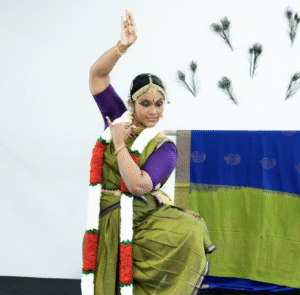
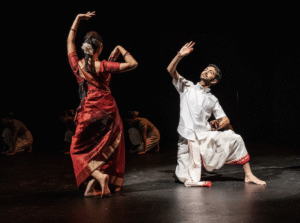
Attuning, an immersive dance-theatre experience directed and choreographed by Meera Patel, inspired by the imagined world of Tanmaatra, inviting audiences to explore elemental states of rock, water, air and light through movement, sound and tactile interaction. Presented as a relaxed, fully accessible performance with integrated Audio Description and BSL, the work positions itself at the intersection of South-Asian classical dance, sensory dramaturgy and audience-led encounter. An ambitious undertaking, offering moments of real imaginative charge.
The performance opened without dialogue but with a clear bilingual framing delivered through BSL, audio description and spoken text. Three guides as one character – Hopper, played by Raji Gopalakrishnan, Natasja Desir and Mira Salat introduced themselves in distinct descriptive modes, supported by additional access facilitators (Helpful Humans) who facilitated in orienting audiences throughout the promenade journey. This layered introductory structure modelled a thoughtful approach to access and the first sign of the production’s dramaturgical density.
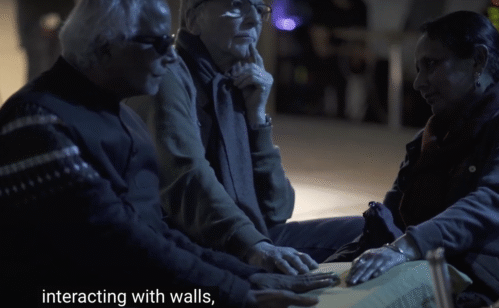
Performed through a trilogy of sequences by three exceptional dancers: Parbati Chaudhury, Shivaangee Agrawal and Maryam Shakiba. We began at a tactile sensory wall, vibrating with the resonance of the table – an effective way of grounding spectators through sound-as-touch. From here we encountered the first character – whose dance interwove cooking gestures, rhythmic Kathak-derived phrasing and an exploration of rock as texture and metaphor. The grainy textures of the set allowed the dancer to interact and use the scenography to enhance the audience sensory experience. A visually impaired audience member near me was clearly enjoying the tactile elements and sonic detail.
Daanu, guardian of water, followed. Her section used rippling fabrics and shifting soundscapes to evoke liquidity – and while visually appealing, the extended dialogue occasionally interrupted the kinetic flow. This section was the most effective as the audience were allowed to interact with the dancers’ costume and directly impact the shape of the choreography. The dancer’s octopus-like costume, with strands distributed into the audience’s hands, beautifully literalised interconnectedness. Inventive costume designs by Kiera Saunders were consistently strong: textured fabrics, malleable sets, and objects designed to be touched allowed audiences to inhabit the world physically rather than imaginatively alone. Those choices spoke to the potential of immersive South Asian dance to move beyond spectatorship toward shared sensory authorship.
The third elemental encounter, Lumyoti, offered the production’s most compelling synthesis of form and intent. The scene evocatively illuminated by Ben Moon’s lighting design. Audience members reclined on vibrating cushions as sitar frequencies pulsed through the body, created by creating a satisfying moment where narrative, design, and sensation aligned. With a sumptuous sound-world composed and designed by Camilo Tirado featuring musicians from the Inner Vision Orchestra and Kaviraj Singh Dhadyalla as Haptics Designer and Maker. This created a delicious marriage of sound, music and melody. Here, the production finally trusted the non-textual and digital design elements to communicate freely and beautifully its intentions of an enveloping sensory experience.
A recurring projected film device – the Future Hopper skits aimed to connect episodes but ultimately diffused focus. A further tension appeared in the overarching Tanmaatra storyline: the world-building was conceptually imaginative yet narratively over-stuffed, especially within the promenade format. The dramaturgy would benefit from tightening. For an experience designed with access at its core, the necessity of dialogue for audio description was crucial, however, the sheer volume of dialogue framing an hour-and-twenty-minute runtime felt unbalanced for a dance production.
Attuning felt sincere, generous and innovative in its access-centred intentions. Great applaud to Patel’s ambition and vision – which offered a powerful multisensory choreographic language with accessibility at the heart of it, aided by Quiplash as Access Consultants. It reminded us that immersion is not built from words, but from the vivid, vibrating textures of embodied experience made through a collaborative effort of art forms, playing out in symphony of sensory sensations.