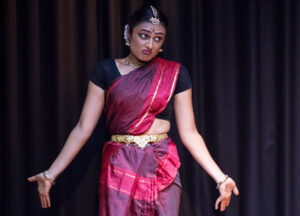
Vidhya Subramanian’s Bharatanatyam Solo
The Bhavan, London
5 May 2023
Reviewed by Sanjeevini Dutta
California-based dancer Vidhya Subramanian is no stranger to the UK. She has taught at Dance India and has been presented by Milapfest and the Bhavan. She can also be seen annually at the Chennai Marghazi, where she has been the recipient of several awards. The performance on 5 May followed a week of masterclasses also held at The Bhavan.
The evening consisted of two extended solo pieces – a varnam in the first half and ashtapadi in the second, with no interval save a mridangam solo. This allowed the dancer to take her time to settle into, to inhabit and luxuriate in her dance.
Dressed in shades of green, tasteful and aesthetically pleasing, Vidhya cut an imposing figure on the stage. I arrived possibly into the second stanza of the varnam. Having missed her introduction, I had to surmise the narrative, but the clarity of expression made it relatively easy. Later when I received the notes from the dancer, I was able to pin down my impressions.
I was struck by the ease and fluidity of the movements and the sculptured freezes. The dancer’s height, figure and clean lines, brought out the beauty of the form.The varnam was titled Samiya Azhaithodi Va, in ‘Navaragamalika’ (‘medley of ragas’), choreographed by the renowned guru and choreographer Dhandayudapani Pillai (1921 – 1974).
The lyrics said, ‘You are akasha, (the sky) and I bhoomi (the earth), won’t you shed a few drops of rain on this parched earth?’ There are several stanzas that describe the longing of the devotee or lover to be united with the divine – the scorching of the moon rays (lyrics from Jayadeva) that need to be cooled in the lakes; finding echoes of Shiva in the vermilion mark on the forehead and Shiva’s matted locks in the rivers and flowing waters. This is familiar territory in classical dance. What raises the interpretation to a different level is the ability to hold several emotions simultaneously – playing with the water for instance has delight, a shiver, childish play and sensuality. There is also an expansive feeling in the dance, as if it has space and an unhurried pace. The audience can relax in their seats.
The episodes are separated by jathis, executed with precision and aplomb – deep araimandis and also sama (upright stance) to preserve energy. Prathap Ramachandra on the mridangam follows the dancer’s actions with sympathetic accompaniment, strong, lyrical or silent, as required. The vocals provided by Vamshi Vishnudas are robust and powerful, the flute accompaniment by Vijay Venkat delicate and harmonious and on nattuvangam, making her debut Ami Jayakrishnan. We are fortunate to have musicians of such high calibre in the UK.
The ashtapadi ‘Kuruyadu Nandana’ by the poet Jayadeva in which Radha is ‘commanding’ Krishna to cool her breasts with sandalwood paste, has been interpreted by bharatanatyam and odissi dance makers many times over. The version choreographed by Kelucharan Mohapatra is indelibly imprinted on the minds of those who have seen it live or on video. Vidhya’s version benefits from the extension of the piece as Krishna has to leave his beloved to press on with his destiny. In a deeply moving sequence, Radha is immersed in the notes of Krishna’s flute when he steals away. The act of kindness, of leaving the music humming in the ears, is beautifully portrayed by the dancer: a mix of pathos, of the joy of love and the pain of loss. In the end that is all that one is left with – that which we carry in the heart. It is a very profound lesson and with gladness we thank the dancer for bringing us on this journey to the moment of realisation.
We have witnessed a dancer in the sweet-spot of the life cycle: the maturity of lived experience with the physical vitality so necessary for dance at its best.