By Kali Chandrasegaram
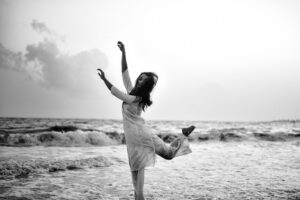
“Let the body lead” is a quote by Balbir Singh on one of his company’s photo docs for health and wellbeing above my photo with wings. I somehow feel privileged to use it! I am not sure if he even realises how profound that statement is? Or maybe he does since there’s always method to his madness as a prolific dance creator and thinker.
As social creatures with a brain we are so focused on cognitive importance that we forget that our body is a living, breathing intelligence. With Fascia in Faschion my intention is to make the body, specifically fascia fashionable! Why is this important in this day and time? I feel the need to reclaim the power of the body is nigh. As the medical institutions and professionals are pushed to the limit we need to the shift of our focus to the body: to look at it as a holistic, interconnected, intelligent, self- healing powerhouse with an inbuilt pharmacy. By building an understanding of fascia, I would contend that there’s no need to completely depend on external “resources”.
As a disclaimer, I am not a therapist of any sort, an anatomist, a scientist, a teacher, a ‘guru’, a personal trainer, a yoga/ pilates teacher. What I am though is a dancer, a choreographer, a movement facilitator, a fabulous drag queen and most importantly a wounded self-healer who is apparently ‘glowing’, the word used by Sanjeevini Dutta the editor of Pulse magazine. Now you know why I got a monthly column on Fascia in Faschion in Pulse (smiley emoji). My passion and believe in fascia is so impetuous that I feel the need to stand at the top of the highest building and scream the importance of understanding fascia.
Just to explain fascia – it is the connective tissue that wraps around and penetrates every muscle, every tendon, every organ. It’s ubiquitous – a continuous bodysuit/ wetsuit from the top of the head to the sole of the foot. It’s a self-organising intelligent internal web, interconnecting all of the cells in our body. It’s a communication highway that provides stability, enables mobility, transmits force, stores/release energy and it is Alive!
Fascia in Faschion is an invitation to try and get a better understanding of the body through fascia. This work is adaptable, responsive, designed with a duty of care and participants’ wellbeing in mind. It’s positioned as responsible and inclusive practice. It’s learning to listen to one’s own body and requirements. At the end of the day the most important thing is that we understand that our own and only body and how we love and care for it is priority. We all are different which deserves a celebration on its own, and there’s no one size fits all when it comes to caring for oneself. I am always astonished not in a good way with the corps de ballet and South Asian dance companies creating what I call “factory manufactured dancers”. Each and every body is different and that needs to be respected.
My journey into fascia began with pain. I struggled as many dancers do with age. And why is that? It’s because I did not understand my body and I did not understand my pain. Indian classical dancers are not taught to understand the body as a self-supporting connective wholistic wonderful thing! The only thing I knew was that the pain kept me awake all night and the next day I was f**ked. And this had to be changed!
I was lucky at that time Balbir Singh Dance Company started the Unmasking Pain Project and I was the guinea pig. Never have I been prouder to be a guinea pig. Through this project, I developed the 5-A method to understanding pain for dancers through objects, movement and looking at the pain outside the body, a genius and groundbreaking idea from Balbir Singh. Below is a glimpse and the detailed concept will be elaborated on in subsequent Fascia in Faschion articles.
- Acknowledge – The Mask
- Accept – The Labyrinth
- Attention – The Frame
- Articulate – The Balls
- Act and Allow – Releasing the Clutched Fabric.
With the support from Balbir Singh Dance Company, I went to Uppsala, Sweden for Fascia- The Living Body Conference 2025. I was astonished, in a good way this time, I didn’t meet any other dancers in that conference and that made me think that we as dancers need to do something about this and I need to spread the word. The speakers at the conference such as Sue Adstrum, Neil Theise, Jean Cluude Guimberteau and Dr Gerald Pollack made a huge impact and spurred my pursuit of understanding this amazing tissue that has been undervalued until recently. More about each of the speakers in the subsequent Fascia in Faschion articles.
When I got back to the UK, I was hell bent on finding a choreographer who works with the understanding of fascia in this country, and I discovered Russell Maliphant and his movement workshops. Led by an artist who totally understands the inner workings of the body, attending Russell’s workshops completely changed the way I move and think of my body.
This led me to a successful application of the Fabric Residency 2026-27 and I am researching and developing a fascia informed movement practice with the South Asian classical dance styles of bharatanatyam, odissi, kathak, mohini attam and bharata nrithyam. With the support from Fabric Dance, I worked with Russel Maliphant and my collaborators of exceptional dancers based in Birmingham – Shane Shambhu, Katie Ryan, Chitraleka Bolar, Nahid Siddiqui and Lakshmi Srinivasan with Balbir Singh as my mentor in this journey.
The Fascia in Faschion research looked at understanding the following:
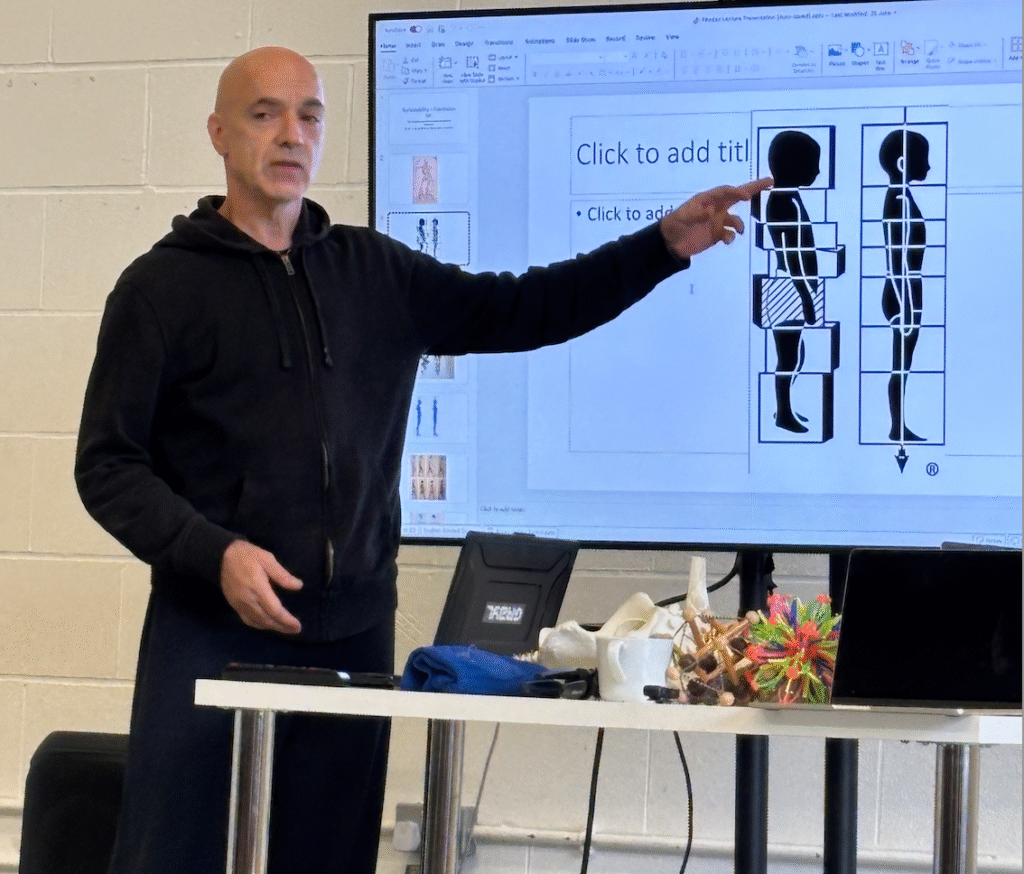
Russell Maliphant at Fabric presentation
-the use of breath
-the body as a whole and connected system
-postural restoration
-the foot in relation to the floor, distribution of pressure on the foot
-the connection of the fascia lines
-the connection from each toe to the spinal vertebrae
-the pelvic floor and diaphragm connection and creating space
-spiral motion of different movements from foot to ankle to calf/shin to knees to thigh to hip abductor
-spiralling of the hip, torso and chest in sagittal, frontal and transverse planes
-connection of shoulder blade, sternum, sternoclavicular joint and clavicle (collar bone)
-connection from each finger to spinal vertebrae
-spiral motion from shoulder to elbow to wrist
-neck movement connecting the spine and shoulder blades
-facial articulation and head connection to fascia line
-finding flow within the structure
Understanding how to work with the fascia through different existing practices in the manual therapy, fitness and somatic fields.
-Breathwork technique
-Fascia Decompression – Block Therapy- Dianna Hanson
-Fascia Manoeuvres – Human Garage
-Anatomy Train – Tom Myers
-Pandiculation – Soma Sensing
-Myofascial Magic in Action (MMIA) – Joanne Avison and Paul Thornley
-Biotensegrity and Rolfing Technique – Russell Maliphant
-Vibration Therapy – Melt Method – Sue Hitzmann
Towards the end of the phase 1 of the residency I came across Rajyashree Ramesh based in Berlin, who developed FasciaNatya and I am completely hooked. I brought her online to work with me and my collaborators. The open sharing at the end of the Phase 1 of this residency in August was very well received. Thank you to the Fabric Dance team for making it all possible.
Detailed introspection through each style to follow in subsequent articles.
n Phase 2, the application of the research and development is in progress. I am looking to work with organisations and companies who would be interested in an introduction to fascia informed practice workshop for dancers, dance enthusiasts, the elders and anyone who interested in movement as medicine.
Until the next article I will leave you with a quote from Sue Adstrum in her book Alive and Kicking: Rethinking Bodies, Health and Self-Care to ponder on.
“The future of healthcare doesn’t just belong to institutions. It belongs to us. One breath, one body and one decision at a time”, Sue Adstrum.